
Category: blog

  • Technical Riding Tips: MTB

    Technical Riding Tips: MTB

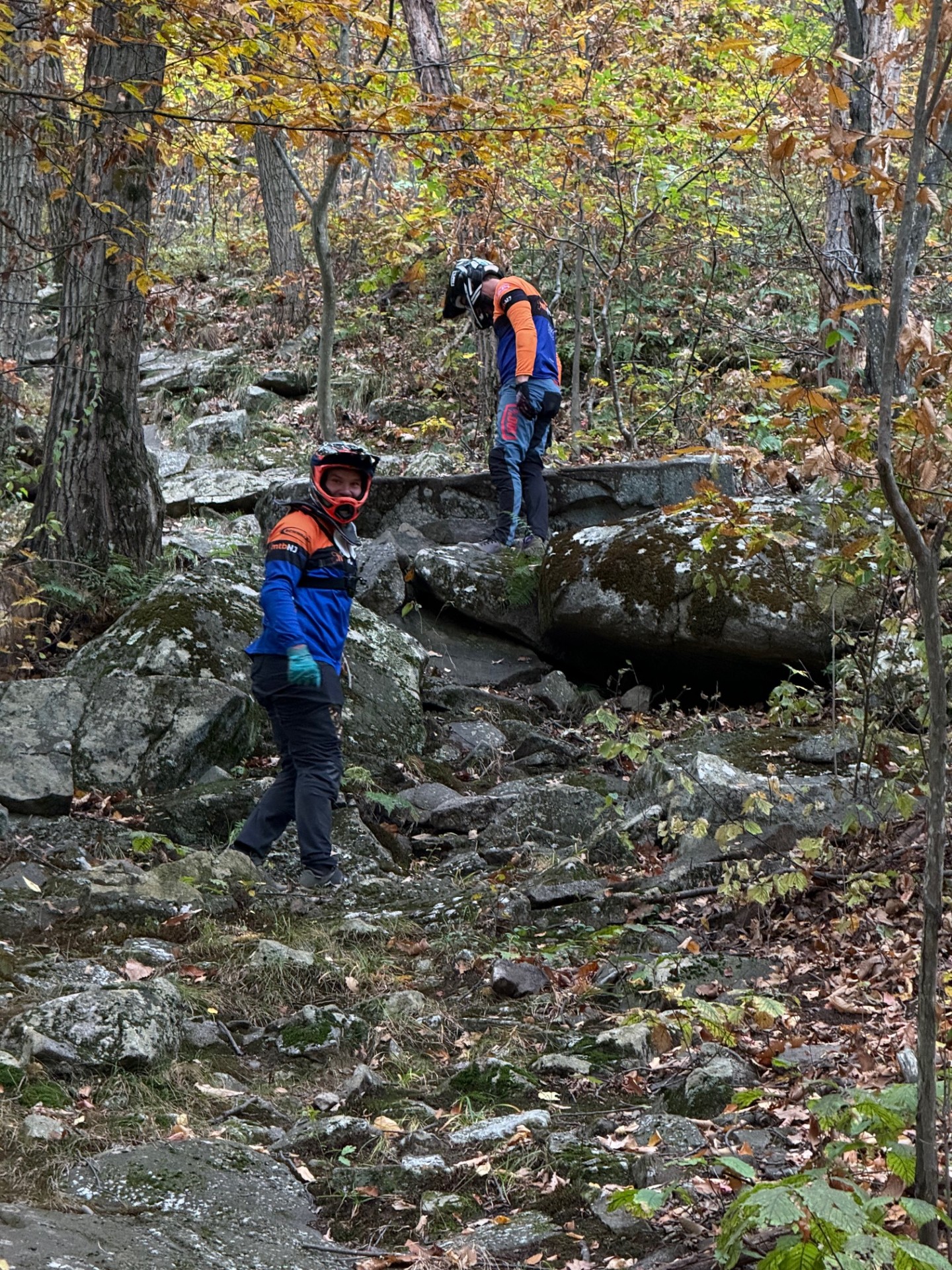
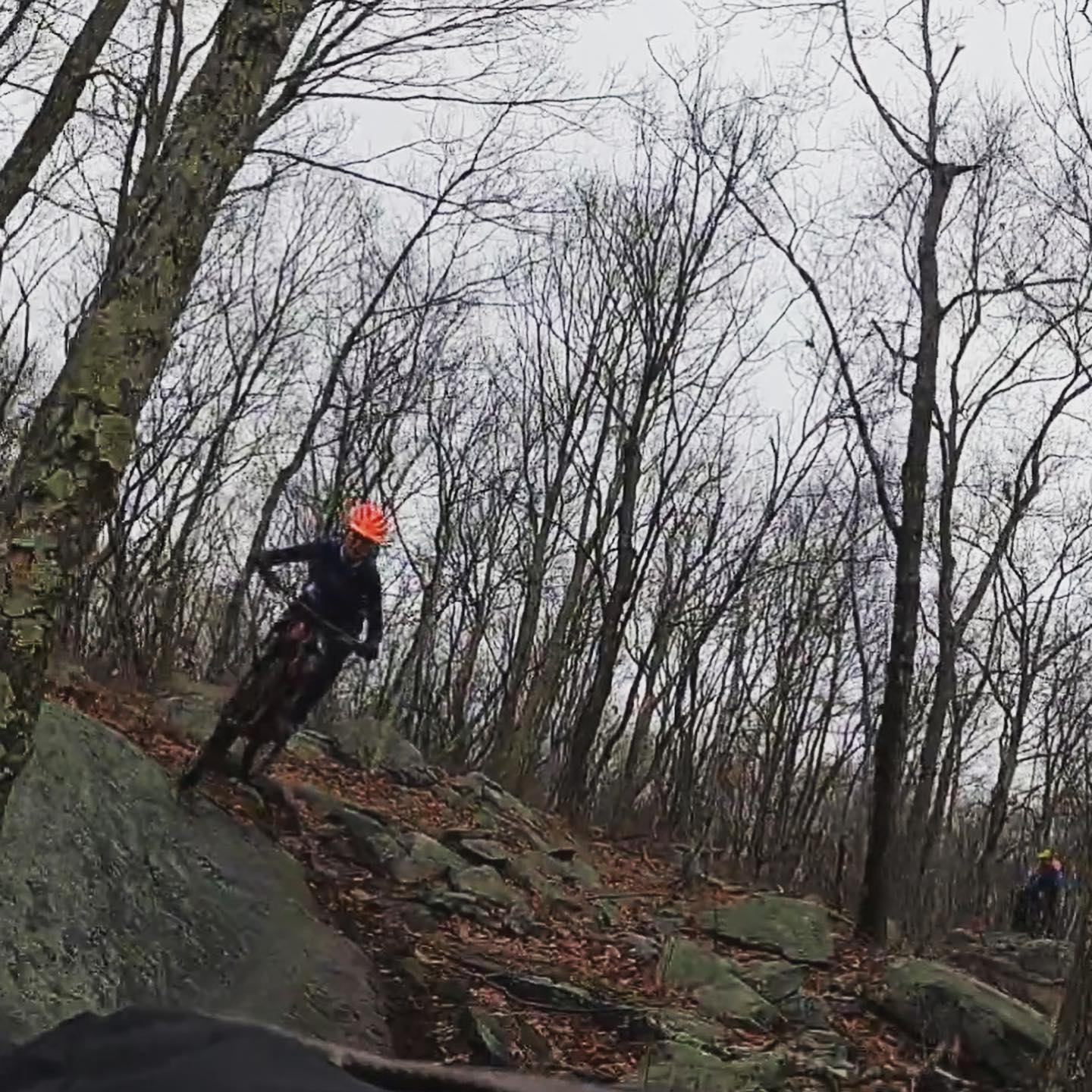
    Technical riding is not your typical cruise through the park. It’s about picking your way through rocks and roots, muscling up steep pitches, navigating awkward slabs, managing tire grip on sheer rollers and keeping momentum on trails that seem designed to throw you off your line.

    Northern NJ is packed with this kind of terrain—one brutal, character-building trail system after another. For many new riders, these early experiences are affectionately called “death marches.” But once things start to click, technical riding becomes addictive: a puzzle, a challenge, and a whole new style of fun.

    Here are four practical tips to help you improve—and maybe even start enjoying—technical mountain biking.

    LEG STRENGTH FOR POWER ON DEMAND

    Raw power is one of your biggest assets on technical trails. Yes, aerobic fitness matters. But technical riding is dominated by short, high-intensity, repeatable efforts—those quick torque bursts needed when your momentum stalls.

    Slow speeds on chunky terrain require more force to keep the bike moving. Whether you’re grinding up a steep boulder, pushing through sandy patches, or clawing over an off-camber slab, strong legs give you a massive advantage.

    Tip 1: Build raw leg strength.

    Mix these movements into your weekly routine:

    At the gym:

    • Leg presses
    • Squats
    • Leg extensions
    • Leg curls

    At a park:

    • Bench step-ups
    • Box jumps
    • Walking lunges
    • Squat jumps

    At home:

    • Body-weight squats
    • Bulgarian (Hungarian) split squats
    • Single-leg squats
    • Front/back lunges
    • Mountain climbers
    • Glute bridges

    Short on time?
    Work “exercise snacks” into daily life. Do 10 squats before leaving the bathroom, or hit a few bench step-ups during your dog walk. Little bursts add up.

    MASTER SLOW-SPEED BALANCE

    Momentum is your friend—but technical trails often don’t give you much of it. When your speed drops, you have to do more work to balance the bike. Excellent slow-speed control is what allows skilled riders to make awkward moves look easy.

    Balance is also crucial in group rides. If the person ahead of you dabs or stops, being able to track stand or crawl forward buys you time and space without putting a foot down.

    Tip 2: Practice Track Stands & Slow Riding

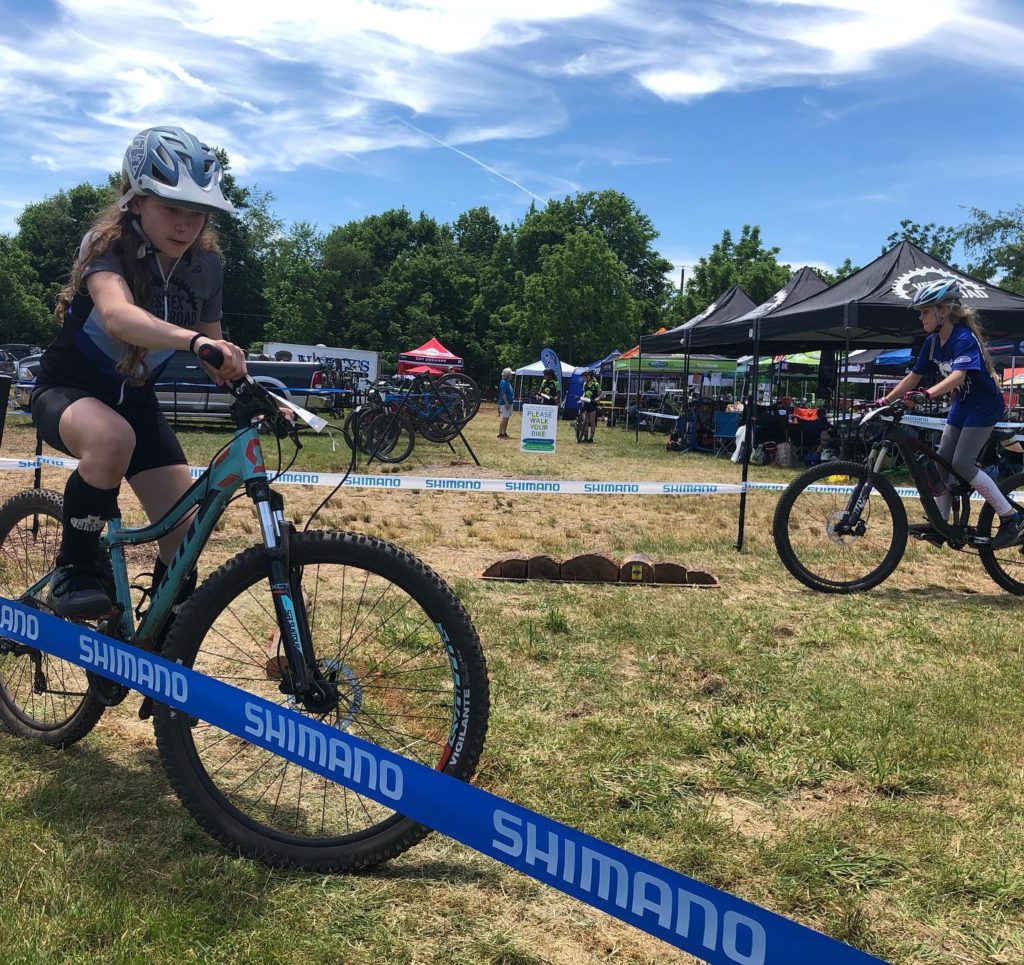
    The simplest drill? Ride as slowly as possible. From there, work toward track standing:

    1. Roll to a near-stop.
    2. Pause for a moment.
    3. When you start to tip, add just enough pedal pressure to regain balance.
    4. Slow again and repeat.

    Over time you’ll build the core and stabilizer strength that makes technical balancing second nature.

    It’s easy to practice:

    • While waiting in the parking lot
    • During regroup stops
    • At the trailhead after your ride
    • Anytime you roll up to your car

    The more often you practice, the better your balance becomes.

    rocky terrain

    TRAIN YOUR NON-LEAD LEG

    Every rider has a “default” foot that naturally goes forward when standing on level pedals. That’s fine—until the trail throws something at you when you’re leading with the wrong foot.

    On technical trails, with back to back obstacles you rarely have time to swap feet before a drop, roller, or awkward feature. Being comfortable with either leg forward is a major advantage and helps prevent those moments where riders panic, bail, or slam on the brakes.

    Tip 3: Develop Your Non-Lead Leg

    Start by riding an easy downhill stretch with your non-dominant foot forward. It will feel strange. That’s the point. Practice this until you feel comfortable with either leg forward.

    As you improve, progress to the ‘wrong foot forward’ while doing:

    • Wheel lifts
    • Bunny hops
    • Small log-overs
    • Switchbacks
    • Rollers

    You’ll feel like a newbie – it’s humbling, but once you gain control with either foot forward, your technical riding confidence skyrockets.

    UPPER-BODY STRENGTH FOR MORE CONTROL & SAFETY

    Technical riding also demands significantly more upper-body strength than mellow trails. Because you’re out of the saddle so often, your arms, chest, forearms, and hands absorb a ton of force.

    Any time you’re supporting more of your weight with your hands—like rolling into a steep chute, lifting the front wheel over a log, twisting the grips for extra traction, or braking hard after a roller—you’re taxing those muscles. Strengthening your upper body helps you stay stable, react quickly, and maintain control when the terrain gets hectic.

    Tip 4: Train Your Upper Body Like It Matters

    Improving your upper-body strength helps you:

    • Stay stable when things get bumpy
    • React quickly to trail changes
    • Control front-wheel placement
    • Maintain confidence on steeper features
    • Keep yourself upright when you land hard off a drop or jump

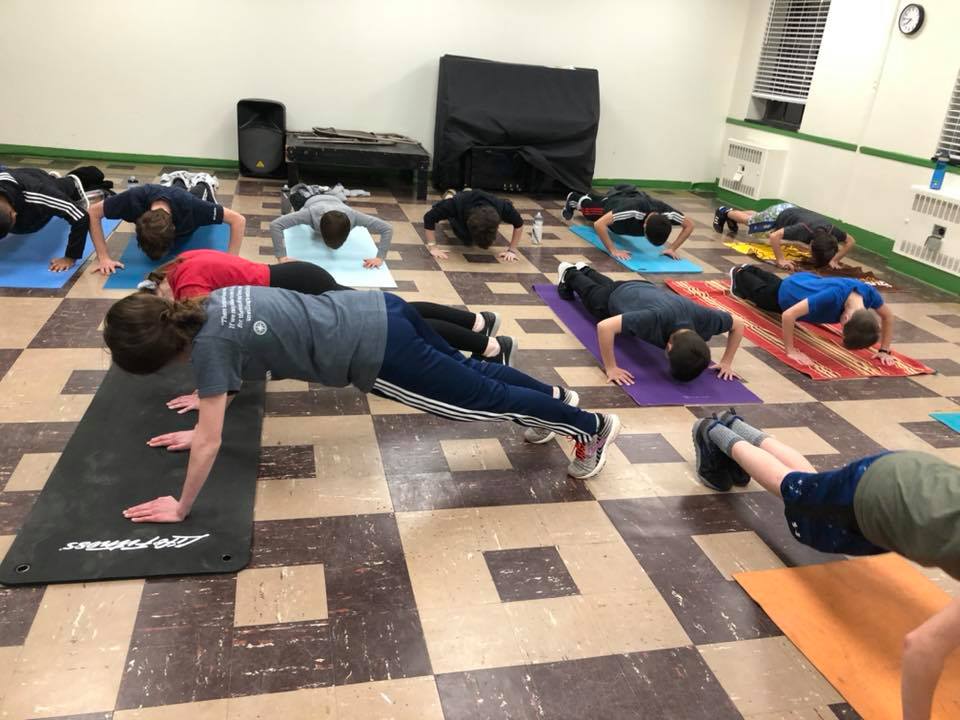
    Pushups, rows, planks, dead hangs, and grip work will all pay big dividends on technical terrain.

    Don’t have a ton of time? Work little bursts of work into your day – waiting for the coffee to percolate? Do 20 inclined pushups against the kitchen counter. Watching TV? Do a set of push-ups to failure between episodes or commercial break.

    KEEP AT IT!

    Technical riding isn’t something you master overnight, but every small gain adds up. Stronger legs, better balance, comfort with either leg forward, and a more powerful upper body all work together to make tough trails feel like a rewarding challenge instead of a punishment. Keep practicing, stay patient with yourself, and celebrate the little breakthroughs—because they’re proof that you’re becoming a stronger, more confident rider.

  • Tips for Promoters: Valuing Women Participants

    Tips for Promoters: Valuing Women Participants

    Earlier this year, a young female mountain biker shared her frustrations about her experience at a local cross country mountain bike race. Her story, in 2021, echoed so many of my own from the last DECADE of racing bikes. It seems that many promoters have some major blind spots for treating women equally to men. I’d like to try to bring some of those issues to light.

    Now, I want to be clear here. There have been some major strides in awareness and a push for events to be more inclusive and respectful of women. And that’s awesome. However, women today are still experiencing lots of subtle, and sometimes not so subtle, moments of disregard and disrespect at cycling events. The good news is that there are a lot of simple, fundamental actions that can be put into practice immediately.

    When I decided to write this article, I reached out to a dozen different women’s cycling groups for input – road cycling, mountain biking, free riding, with local, national and international scopes and I received HUNDREDS of responses, with many of the same issues occurring on all levels of racing, all over the world.

    The following are some common threads and how a race promoter can handle or address those issues. This is by no mean exhaustive, but I hope it’s helpful.

    1. Marketing

    Include images of women in you’re marketing materials – that’s anything from social media posts, event banners, post-event articles & write ups, or video clips. Look at what you’re currently posting, printing and publishing. Analyze how often you’re displaying images of women vs images of men. Even that up by deliberately including & featuring women.

    2. Access to Toilets

    Nothing says, ‘We don’t care about your needs’ more than not providing restroom access at a race or event. That may require CONFIRMING a public restroom will be unlocked for the event, then CHECKING that indeed the park/facility unlocked it. If it is brought to your attention that the restroom, which your event should have access to as per the permit you paid for, is not in fact available to participants, be outraged & take action.

    At a minimum, there should be toilets at the start of the race. Major bonus points for any long format course that offers porta-potties at a strategic location along the course. Women literally cheer when they see a porta-potty, I’m not joking. To put a finer point on this, on average, women menstruate 1 out of every 4 weeks. That means that at any given event, you can expect 25% of the female participants are dealing with their menstrual cycle. Peeing in the woods isn’t going to cut it.

    3. Equal Prizes & Payouts

    It’s simple – EQUAL PAYOUT. Period. Full stop.

    Don’t place participation requirements on the women’s categories (I’ll explain why that’s absurd in point #7). This goes for swag prizes too – offer the same level of swag items to both the men’s & women’s categories. Ideally, the same exact items to all 1st, 2nd, 3rd place winners regardless of gender.

    Don’t give women men’s clothing. Just don’t. It doesn’t matter if it’s high quality and expensive. Consider this, would giving a man a piece of women’s clothing be well received? Women feel it’s just as inappropriate.

    4. Equal Treatment During Award Ceremonies

    It’s awesome to call out race times during the podium ceremony. If you choose to do so, do it for ALL the categories. If you call it out for the first place winner only, or for only the pro categories, that’s fine, but treat the men and women equally in equivalent categories.

    Intermingle the women’s & men’s categories during the award presentations. This is especially important if the prizes include choosing from a swag table. It’s way to common to call out ALL the mens’ & boys’ categories first. They get choice of swag on the ‘choose your own table’ and the women are left to the very end with everything picked over.

    It’s a much better scenario to have equal prizes reserved for the podium positions and then raffle off or give away the leftover swag in another way like a crowd toss, to segment winners, or in some other creative manner.

    5. Equal Distance / Duration

    Either distance or duration should be equal for both genders. The selected metric will vary depending on the discipline and course. For example, duration is the main focus for cross country, cyclocross and criterium races, while distance should be equal for marathon, downhill, freeride, enduro and road disciplines. Not sure what your discipline should do? See point #9

    6. Equal Categories & Starts

    I’m sure this will be a contentious point, but ideally, offer the same categories for women as you offer for men.

    Women are discouraged from participating in an event if they are forced to race against women 2-3x younger or older them themselves. They want to race amongst their peers, and they want to have a choice.

    At the very least I would suggest having a juniors category, an open category and a master category in each level of racing. Not sure if this point is relevant to your discipline? See point #9.

    Don’t combine women’s classes, either amongst themselves or with other categories, at the event unless you speak to the women first. If there is 100% agreement of participants – great, make a change, if not, respect their choice to start and race against their competitors.

    Start the relevant men’s and women’s categories at similar times. Don’t push the women onto their own day, after or before the men’s racing or at other undesirable times. Amateur categories should get the less desirable & attended time slots.

    If you expect the event to sell out, reserve a segment of entries for the women’s categories.

    7. Figure out the Math

    I heard over and over again women were subjected to arbitrary math rules. This applied to everything from equal payout, to qualifying for race heats, to team qualifications to invitational events.

    Let me give you some examples.

    1. Payout Qualifiers: Some local XC races require the pro women’s class to have 10 participants in order to receive the same payout as the Pro Men’s Class. Two issues with this one…

    First, individual categories do not fund their class payouts. Payout for the Pros is funded by the amateur classes, so there is no reason to place an arbitrary requirement on the Women’s Pro Class.

    Second, the targets are usually grossly unreasonable. Let’s say a local XC mountain bike race typically gets 5 pro women, on average, registering for the event. The typical attendance would need to DOUBLE for the women to receive full payout. Would any promoter EVER require the Pro Men’s class to DOUBLE their participants from one year to the next before paying out the full prize money? Nope. Never.

    2. Qualifying Rates: In some UK collegiate downhill races, only 10 females can qualify compared to 100 men. The low qualifier rate and rules about belonging to teams impacts scoring so that women are typically awarded only a gold medal and no silver or bronze while the men receive medals for all 3 places.

    What’s the tip here? Don’t set arbitrary numbers. Figure out the math, look at the historical participation data and the event’s participation goals before setting up the rules.

    8. Respectful Announcers

    Race announcers should be vetted for professionalism before being handed a mic. Comments about body size, hair color, strip clubs, etc.. have no place at a cycling event in any way shape or form. (You know who you are)

    9. Just Ask!

    The single most important tip I can offer is this: ASK WOMEN FOR FEEDBACK & INPUT.

    If you want to know how to improve your specific event and event experience, ASK THE WOMEN attending, and those who have attended in the past. How was their experience? What could be improved? Why didn’t you come back? Was this change better or worse… ? Would you prefer option 1 or option 2?

    Many women have experiences at events that are less than stellar – but they tend to keep it to themselves because no on wants to be a ‘complainer’. But if you seek feedback from the women attending your current & past events, I guarantee they will have advice, suggestions & insight on how to improve the experience.

    Small Steps

    I have been involved in bike racing on the participant, race promoter, and series promoter level. I have raced grassroot events and local series, as well as many regional and national events. I’ve participated in road races, criteriums, time trials, XC, cyclocross, enduro, short track and endurance events. I’ve seen race promotion from many angles, in many disciplines and I’m often asked the same question, “Why aren’t more women participating?”

    I don’t have a concise answer to that question, but I am trying to chip away at the issues contributing to low female participation. I hope this helps.

  • 2020: the season that wasn’t & life’s sharp left turn

    2020: the season that wasn’t & life’s sharp left turn

    2020 was a shocker of a year. Heading into the early months of February and March I was feeling dialed and ready to rip the enduro scene. I was fully committed to training & improving my skills over the winter. This excitement quickly turned to disappointment as news of the pandemic broke out and it’s ramifications became clear:

    Racing Is Off The Table Until Further Notice

    As disappointed as I was that races were being cancelled, there was a silver lining. My life had been raging at a break neck speed and the lockdown forced me to slow down, value my time more and de-value external demands. I spent a lot more time with my immediate family.

    Just When I Was Getting Comfy…

    As I settled into enjoying the break from the pressures of racing, training, coaching, & volunteering, life hooked a sharp left and I found myself held hostage at my local hospital – confused, scared, isolated. This was mid May. Here in NJ we were still deep in the initial Covid peak and a hospital was not where I wanted to be.

    Riding Isn’t Just Pushed Aside, It’s Not Even On The Table

    I’ll keep this part brief, but if you’d like the long-winded version of this experience, you can read it here. I woke up in the middle of the night with a severe stomach ache. I was in the hospital for about a week, where they removed a large cancerous tumor along with a foot and half of intestines from my abdomen. My world shifted so fast and so hard I felt completely dislocated from the ‘me’ that’s always been, I was utterly disoriented, bouncing between exhaustion, rest, stress and utter intense focus to educate myself about gastrointestinal stromal tumors.

    There was a lot of doctor appointments. Follow up scans. Bloodwork. Second and third opinions. There was a lot of worry. If you’d like to read more about my recovery and dealing with a cancer diagnosis, that’s here. There were hours and hours of discussions with family and friends hashing out every single detail of every document, every report and every appointment. Each doctor visit or call was its own roller coaster of emotion. Every time I thought I had things figured out, I’d be shocked by some new piece of information or new understanding.

    The Slow Road Back to Two Wheels

    I had 6 weeks of rest waiting for my intestines and abdominal muscles to heal. Unlike any other injury I’d had, the recovery was not a smooth path. Intestines’ are a fickle thing, and it’s not obvious what their status is. I came a hair’s breath from having another surgery.

    I approached recovery like any other goal – clarify the big-picture, figure out the steps to get there, focus on 1 step at a time, celebrate small achievements & accept that this would be a lengthy journey.

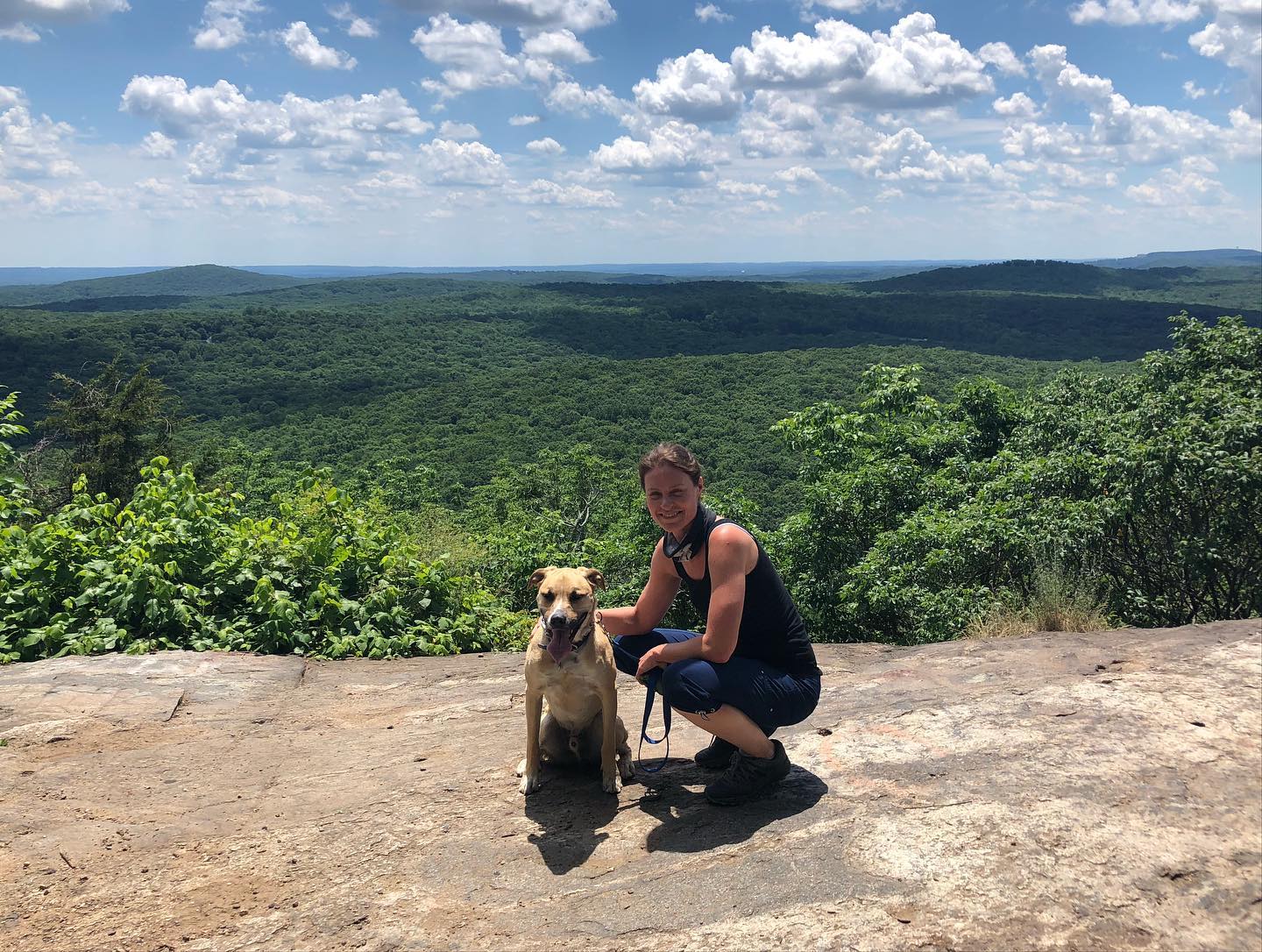
    I eased back into activity with my dog Odin. As the weeks went by I started seeing gains. I went from not being able to walk around my block without stopping to rest, to jogging 5 miles. I started hiking and eventually made my way back on the bike. I implemented a home physical therapy routine for my abs & incision scar and eventually got back between the tape, winning an enduro at Glen Park, before 2020 came to a close.

    Along side this recovery I was dealing with an undercurrent of anxiety and the lingering side effects from the chemo drug I’ll be on for the next 3 years – but it’s all manageable. One thing I learned to do over the last 12 months is to take a day – when that emotional turmoil boils up to the surface – take a day – or 2. Take whatever is needed. And here’s the key – there’s no need to feel guilty about it.

    Heading into 2021, I’m Keeping My Options Open

    I don’t have many expectations for 2021. In terms of cycling, I’m going to continue to improve my fitness, strength & skills on the bike. I’m planning on doing some racing – just not nearly as much as I used to. I’ve got a lot of things on my bucket list and plans to tick them off sooner rather than later.

    Cancer-versary

    May 16 marks 1 year from my tumor surgery. Last week I had the ‘1 year CT scan’. There is no evidence of any disease. My bloodwork indicates that my liver is handling the imatinib rx without any issues and I’ve graduated from seemingly constant oncology visits to a 3 month period before my next appointment.

    Although all of this brings a feeling of relief, it doesn’t fully quell that underlying layer of anxiety – I’m not sure anything will.

    In the meantime, I’m going to make the most of my time on and off the bike, because there is no time like the present.

  • After the dust settles

    After the dust settles

    The next couple weeks were focused on recovery and rest. My family took excellent care of me. I’m very careful with my diet – eating only soft foods, soups and lots of smoothies. Friends and family inundate me with flowers and get well cards and I catch up on a lot of movies.

    I saw my surgeon in his office. He hinted at cancer but never made a direct statement. The biopsy was supposed to take 5 days, but this tumor isn’t common, so it had been shuffled to different labs for verification before final results were sent back to him. He is pleased with how the incision is healing and approves longer walks and light jogging.

    When the surgeon finally calls with the results more than 14 days post-surgery, he tells me it’s a gastro-intestinal stromal tumor (GIST) and lets me know surgery was probably the only treatment needed. I take that to mean it was not cancer. He asks me to see an oncologist to confirm treatment.

    I got a recommendation for a gastro-oncologist and head over thinking this is going to be a short and semi-pointless consult. I’m retelling my story, he’s reviewing the reports, and then he looks at me and says, ‘So it looks like your in remission…’ I immediately interrupt and say, ‘Wait, what? Remission? That’s a term you use when talking about cancer’. He can see plain as day I haven’t heard any direct statements, so he pauses and then he patiently restarts from the beginning.

    He states that the tumor is cancer.

    He defines the type (sarcoma) and explains various details, he answers all my questions until I’m just sitting in quiet disbelief. It’s not a short appointment. My husband is with me and is just as rattled as I feel. We head home and the anxiety floods in. What does this mean?

    I dive into researching every last word on every report – the surgical report, the ct reports, the biopsy results. I get genetic testing done, I have a coloscopy & endoscopy, there are more biopsies sent out. I get second and third opinions. I talk to my family and friends. My sister works in a hospital setting and we discuss every last detail of every appointment, every opinion, and every report. She uses her access to scientific research to precure more information. I have more appointments with the oncologist.

    Every time I felt like I reached a level of understanding or felt a sense of security with the situation, the next doctor appointment or scan result would rip that footing away and I’d be spinning in a sea of anxiety.

    The worst one was a follow up CT scan they did to inspect my other organs for evidence of cancer. I had been told over and over again that there was no evidence that the cancer had metastasized – ie – it had not spread past the one tumor. This scan was simply part of the standard treatment routine. My tumor was medium risk based on how fast it had been growing, and it was stage 2. Stage 2 is good – that’s early – and you know what everyone says, when you catch it early, better outcomes.

    The doctor called and told me they found a spot on my liver.

    The liver and the lungs are the 2 organs that this type of cancer metastasizes to first. I’d learned that from the doctors and from the internet research I’d done. Now, he also said there’s not need to panic, it could be any number of things, but I’d need an MRI to better view it and determine if it’s part of the cancer.

    For the majority of this experience, and up until this point, I had been able to keep a level of hopefulness and positivity going. This news, however, broke me. Suddenly, not seeing my kids graduate high school was a real possibility. I’d miss their birthdays, their milestones. I’d miss seeing them create their own families. Should I pre-write birthday cards for them, and how many? Would getting a birthday card from me after I’m dead make them feel loved or just create unnecessary heartache? The unfairness and randomness of it all was crushing and I absolutely lost it.

    The good part of COVID is that with everyone hunkering down at home, I’m able to schedule appointments very quickly. I get the follow up MRI done a couple days later and the doctor calls with results that same day letting me know that the spot on my liver is not part of the cancer.

    I’m elated… for the moment.

    The roller-coaster of emotions wasn’t limited to just doctor calls, there’s the experience of telling my friends and family it’s cancer. As if this whole situation isn’t stressful enough, waiting for and dealing with their reaction is rough – everyone is initially shocked, which makes sense, but then many seem afraid – afraid of the word, afraid for me or afraid of me – sometimes all three. It’s surreal.

    With most people though, we are able to get past that initial awkwardness and get to a real discussion. Talking about it helps me process what’s happening, it helps me solidify my understanding, so I talk a lot.

    I’ve never experienced this level of emotional turmoil – the ups & downs were drastic in the first couple months post surgery and I’d have days where I just had to shut off – I couldn’t focus on work for any length of time or accomplish simple household chores. It was just sit in the backyard, toss a ball for my dog or sleep.

    I am so grateful to have such incredible people – family & friends – in my life helping me get through all of this. My husband Jason, my sister Debbie – I would have been a disaster without them.

    I’m a year out now, and am back to life-as-normal, but there is an undertone of anxiety that lingers. Once in a while it’ll rear back up – a doctors appointment or periodic scan for example. It’s always there, nagging quietly in the back of my mind. I’ve spoken to a lot of cancer survivors who have a similar experience – the anxiety never leaves, but it does fade into the background.

    I try and use it as a reminder to appreciate what I have right now and to take action on my bucket list items rather than wait. And if I need a day to tune out, I take it.

    Meanwhile, I’m frustrated by how long soft tissue takes to heal.

    Some days were good, some days were not. I had to be careful with what I ate, and once in a while my intestines would act up. At one point, about a month after a my surgery, I got that “backed up” stomach ache that started this whole fiasco – it felt like another intestinal blockage.

    Off to the urgent care I went for yet another CT scan. They found that my intestines’ were indeed blocked again. The intestines appeared ‘flattened and closed’ at the surgery spot. They could see swelling before the surgery point and deflation after that point – like a balloon pinched closed between your fingers. Sometimes the scar tissue can stick to itself they told me, causing this type of blockage.

    They transferred me to the hospital. I did not want to be here. I did not want to go through this again.

    My surgeon looked at the films and had everyone wait. Sometimes, he said, if the scar tissue isn’t healed together, this type of blockage can sort itself out with hydration and laxatives. The pain had receded so that was a good sign. They pumped me full of fluids and after a few more hours passed the surgeon stopped by to poke and prod my abdomen. He determined that the blockage had indeed cleared on it’s own and I sent home without any other treatments.

    As the days and weeks pass without any other complications, my desire to become more active, specifically to ride my bike, kicked in.

    When can I start riding again?

    I walked everyday – after most meals, especially if I had any odd stomach aches or pains. I worked up from struggling to get around my neighborhood block without stopping to a few steady miles. My dog is super energetic and strong, so I spent the early weeks diligently training him to not pull or chase squirrels on our walks. The surgeon was very clear that I had to be careful not to lift or strain while my abdomen healed. There was a lot of freshly boiled chicken involved. We slowly progressed to jogging and I rekindled an long-passed passion for running. After what felt like an eternity I was able to return to riding.

    I was happy to be on two wheels, but my body was not right and the idea of training or racing seemed very distant. Despite this, I stayed positive, and approached recovery like any other goal:

    • clarify the big-picture,
    • figure out the steps to get there,
    • focus on 1 step at a time,
    • celebrate small achievements &
    • accept that this would be a lengthy journey.

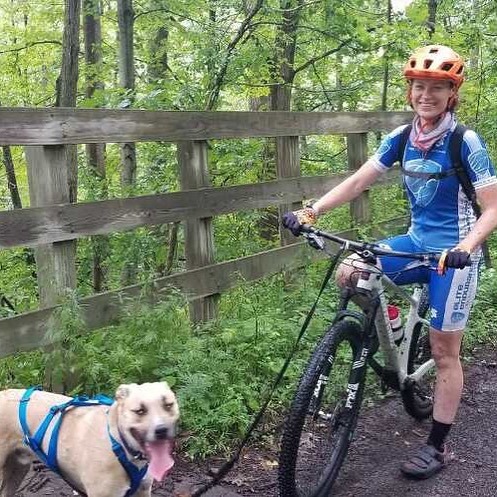
    I’d ride a few miles feeling great and then my back wheel would slip on gravel or wet rocks and it would feel like I sprained my abs. I avoided riding in any wet conditions whatsoever, and had to avoid technical trails and features (my favorite stuff). I bridged this weakness by getting my dog Odin a sled harness and bungee leash so he could do the pulling when conditions were less than ideal. I also started a home physical therapy routine targeting my abs and cupping for the scar tissue.

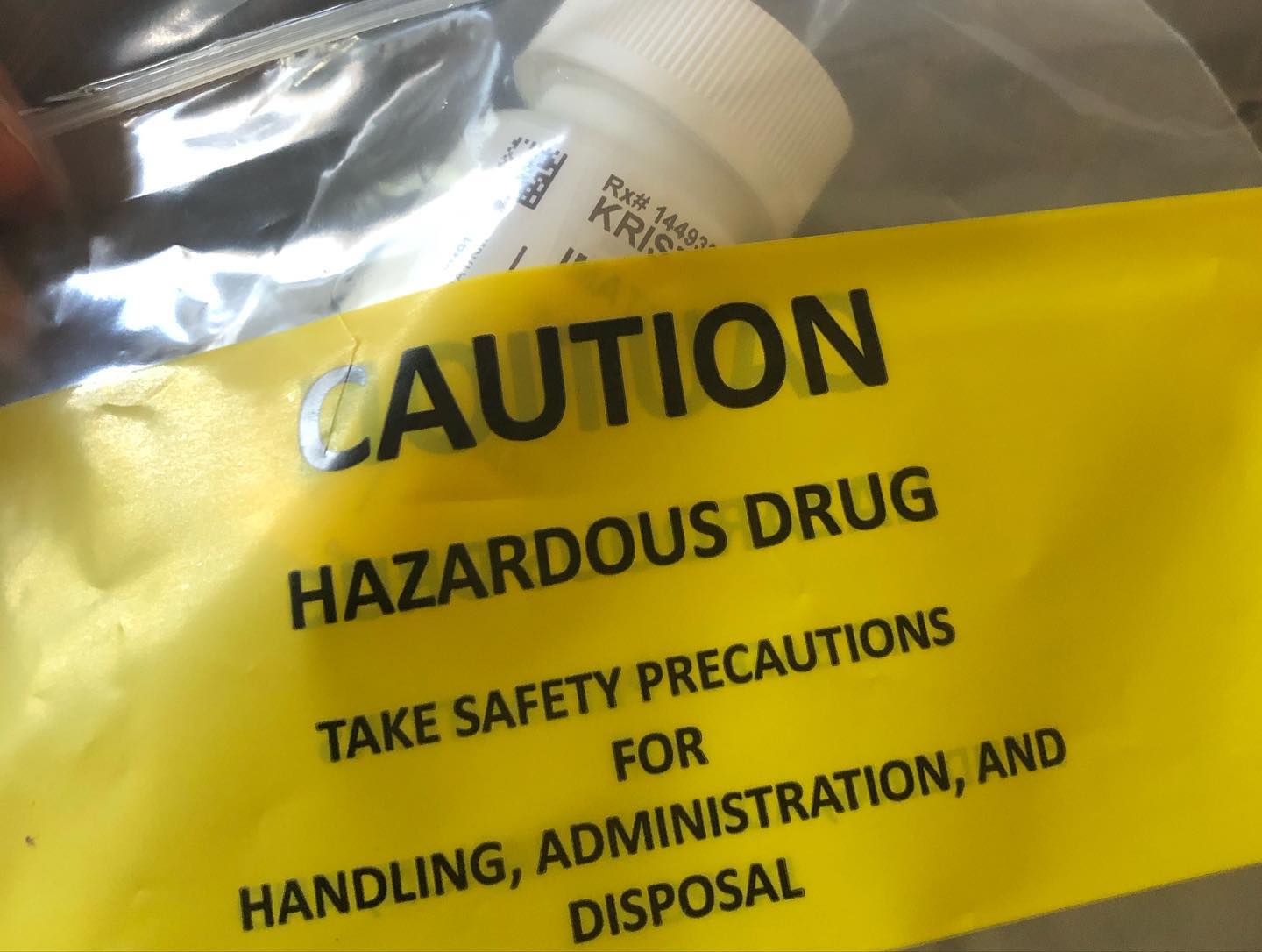
    Part of my cancer treatment is taking imatinib (gleevec) for at least 3 years.

    It’s a chemotherapy drug that has minimal side-effects relative to what you’d normally think of when someone say’s “chemo”. The side effects were stronger initially – nausea, upset stomach, fatigue, flu-like symptoms & muscle cramps – but I’ve adjusted to the medicine and can deal with the lingering issues that pop up – I go to bed earlier or take an afternoon nap, I take magnesium and electrolytes for the muscle cramps and I have an anti-nausea med to combat any upset stomach.

    Returning to Glen Park

    In the back of my mind this whole time I’m weighing whether or not returning to racing is a reasonable expectation. I find true happiness on my mountain bike – that feeling of flying through the woods – I love it. I also find great joy in the process of setting, pursing and achieving goals – racing gave me a clear set of targets, but I don’t necessarily need to race to find contentment, so I decide that I’d be okay with not racing anymore if my body just can’t take it.

    As the fall of 2020 rolls in, an enduro at Glen Park opens registration. I love Glen Park! But I am pretty far from anything that looks like ‘race shape’. What the hell – it’s a day on my bike at a place I love seeing people I like – that’s more than enough to convince me to sign up.

    My teammates & I head to the park the weekend before the race to get some extra time in on the trails. That double that scares the crap out of me? What do I have to lose by going for it? Today, I’m feeling good, tomorrow, I might not. Let’s not wait another day. I clear it.

    I have to do it again. And again. [You can watch it here: https://www.facebook.com/1487105181551108/videos/1904567559673805 ]

    The following weekend the race is hard, but it’s an epic day. I’m exhausted by the back to back riding – pre-ride & race day. Between the meds & my poor fitness, recovery is harder than ever, the muscles cramps are vicious at night after a hard day workout, but I’m so happy to be out there, that none of that matters.

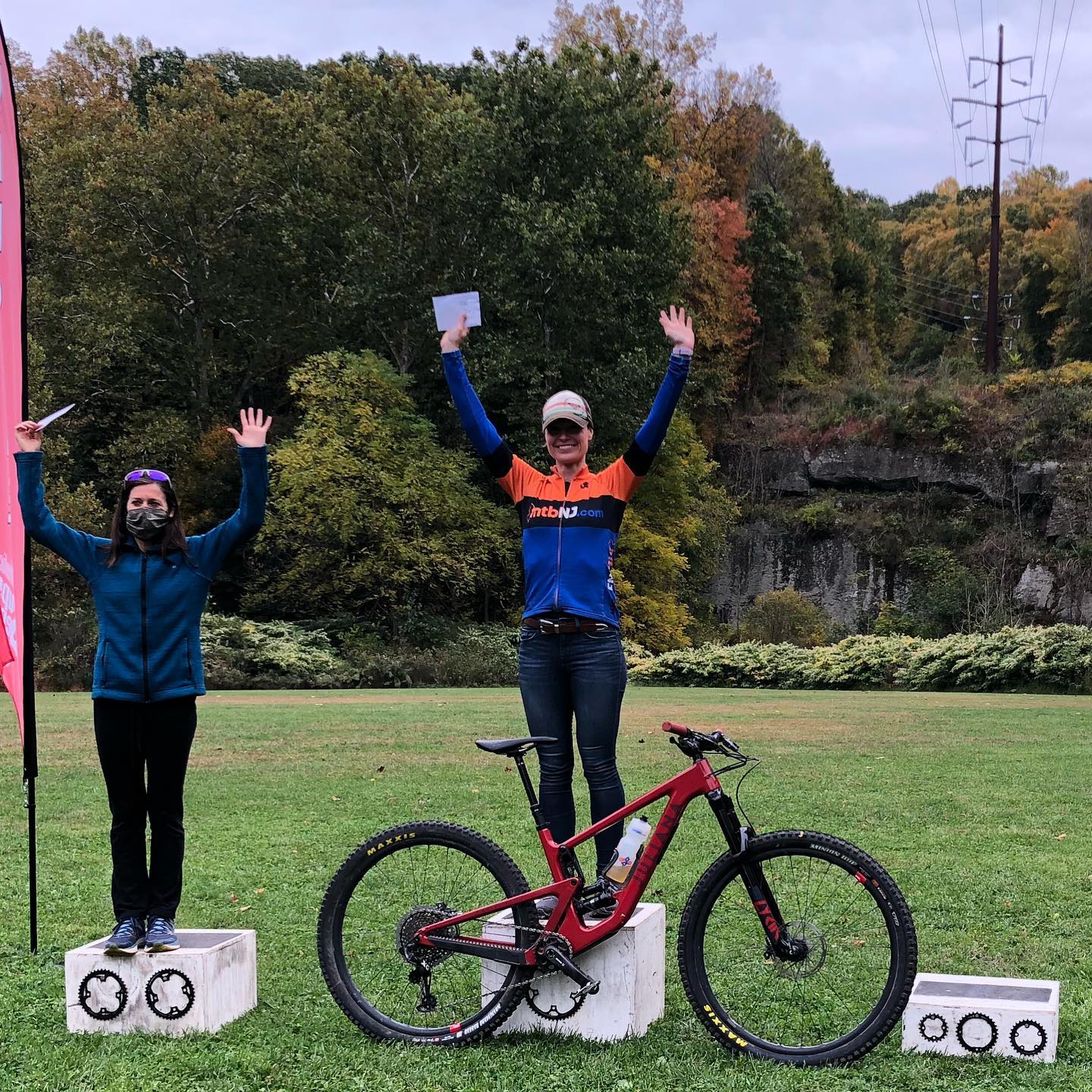
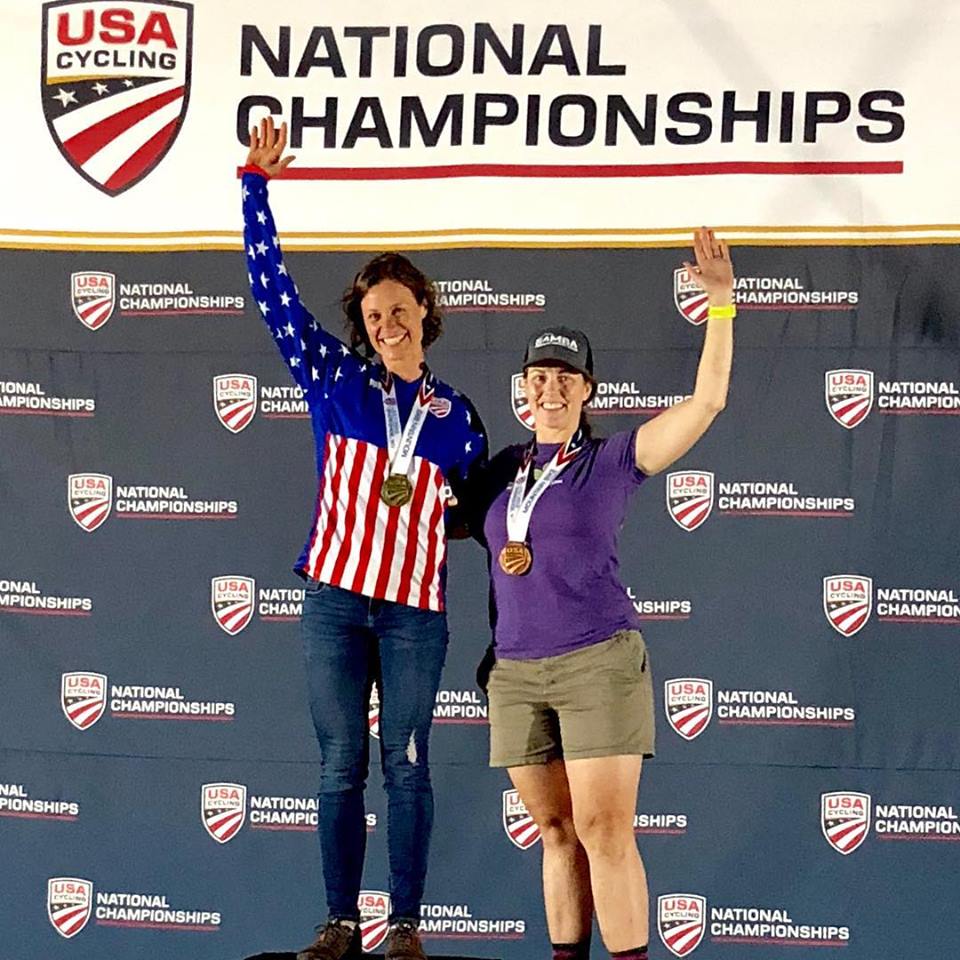
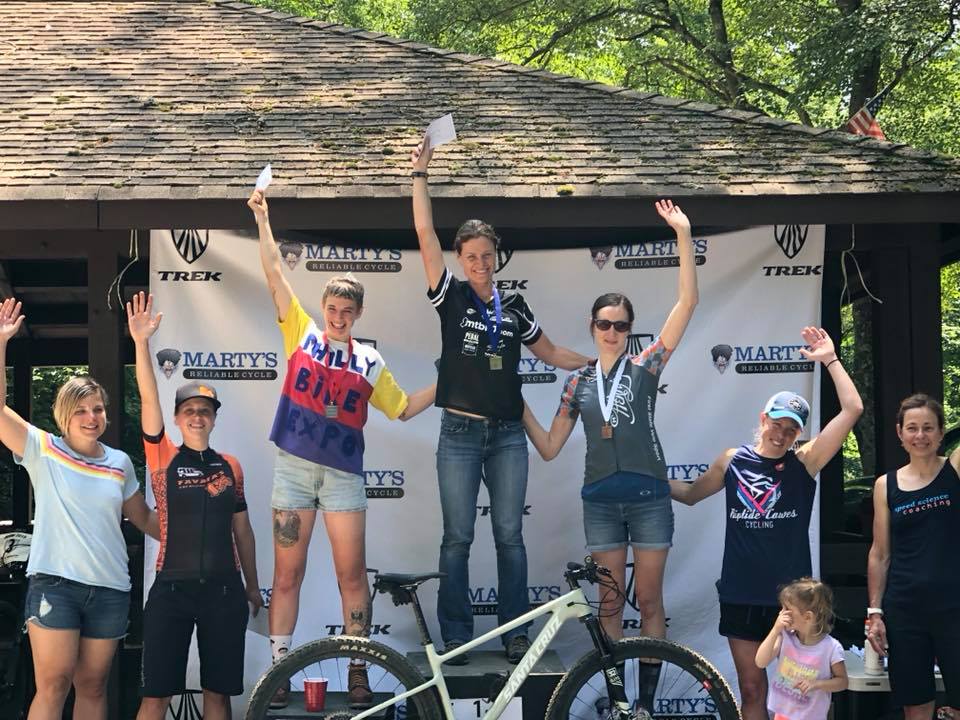
    By the end of the day I find myself standing on the top step of the podium and I’m pretty emotional. I can see a path back to racing – this chapter doesn’t have to close just yet – which is good because I’ve got a few bucket list items to knock off my list first.

  • Emergency surgery during Covid, a detailed account

    Emergency surgery during Covid, a detailed account

    Mid May, I woke up in the middle of the night with a severe stomach ache. By morning I was in absolute agony. My husband dropped me off at the nearest hospital (Covid rules = no visitors allowed). This first day seemed to go by pretty swiftly, the doctors saw me right away and scheduled an abdominal CT scan. Since I had to drink contrast fluid and wait for it to work through my intestines, there was a couple hours of waiting involved. The doctors had started an IV with pain meds, so I was feeling pretty good at this point – except for the Covid nasal swab – the early version where they had to swipe the back of the sinuses was eye-watering awful. As I waiting and starting to feel better, I remember thinking this is probably going to amount to nothing and I’m wasting everyone’s time.

    When the results came back the ER doctor visited and let me know I had an intestinal obstruction and that I’d need to have it surgically removed. Her slightly enlarged eyes and barely concealed pity gave me an uneasy feeling. This feeling compounded when my questions were not answered directly or specifically.

    “What’s causing the Obstruction?”
        “Could be any number of things…”
    “What will the surgeon be doing exactly?”
        “Depends on how he wants to handle the obstruction… He’ll be able to give you those details when he talks to you, let’s get you admitted”.

    I like information. Clear, detailed information. I didn’t get any for days.

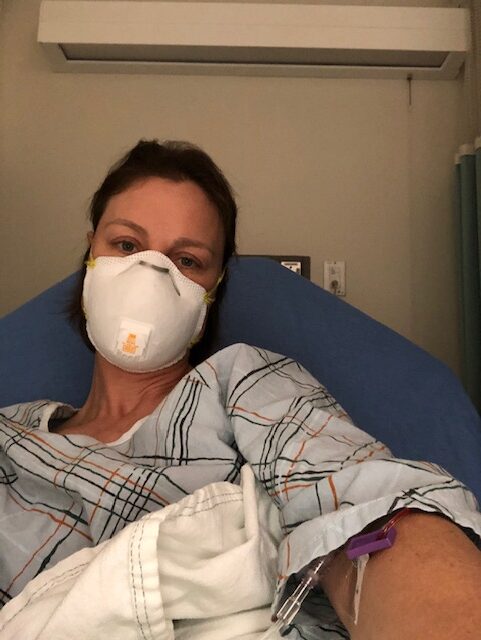
    Hospital admission during a pandemic looks a bit different than any other hospital experience I’d had before. I had my own room. The doors were heavy, always closed and completely sound proof.

    When I’d ring for a nurse, it would take anywhere from 1h to 3h for an actual person to visit my room.

    When a nurse did appear, they often had difficulty managing their normal tasks due to ill fitting and excessive PPE gear. The staff fielding the ‘help desk’ calls never had any information. I was just sitting in a room, waiting.

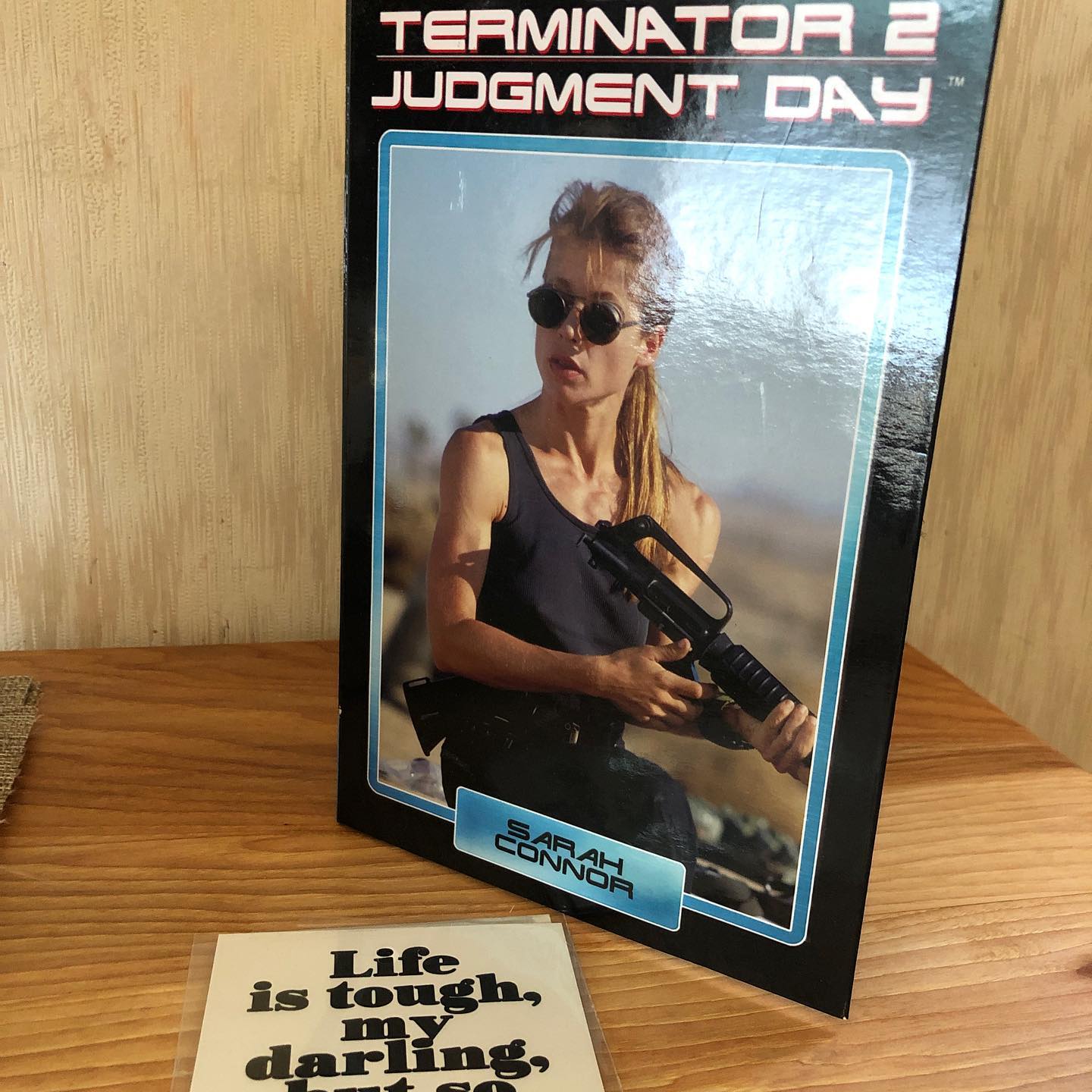
    Channeling Sarah Conner

    On day two I was expecting more information but I really didn’t get much. I flipped between feeling incredibly uneasy, unsure of what was going on and utter boredom.

    I hadn’t eaten anything since the night before I went to the ER and my stomach ache had completely disappeared. My body was back to feeling normal and it felt weird to be closed into a white, institutional room, far away from my husband, my kids and my mountain bike. I spent a lot of time on the phone talking to family and friends. When the attending doctor finally made a visit late in the day, he was shocked to find me knocking out pushups on the floor.

    Various doctors came and went after his visit – a gastroenterologist, a pulmonologist. No one had much info for me. The obstruction could be a collection of debris like seeds, it could be a growth, it could be twisted intestines…

    The obstruction was a tumor.

    I can’t recall exactly when I saw the surgeon for the first time, but he was direct and clear.

    The obstruction was a tumor, a large one – bigger than a baseball. I needed to stay in the hospital instead of waiting for my surgery appointment in the comfort of my home because the tumor could rupture – and that would be BAD.

    Yes, this could be cancer, but that’s unlikely, and we won’t know anything for sure until the biopsy comes back. Yes, he does hundreds of these surgeries every year (removing a section of intestines and reconnecting), but not usually due to a tumor – those he only sees once a year. He’d be sewing the intestines up with titanium stitches that will forever be visible on future scans & x-rays.

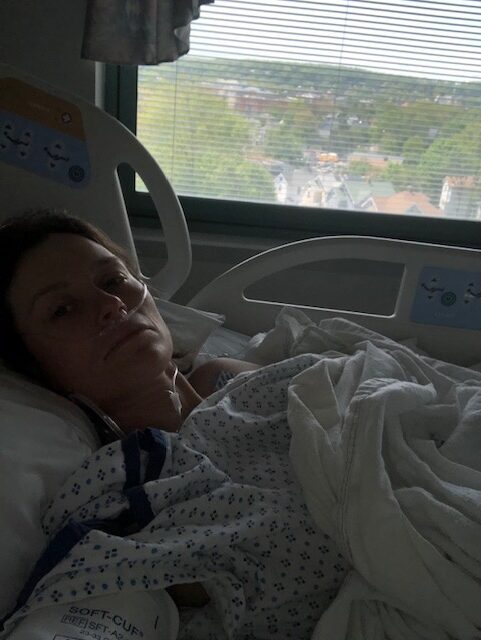
    Sunrise from my hospital room

    It would have saved me a metric-ton of worry if any doctor had told me any portion of that information in the ER. But now I understood the ER doctors & nurses shocked look and undertones of pity.

    A baseball? Jesus, how can that be?

    At 5-8 and 134 lbs, how did I not notice a baseball in my abdomen?

    Surgery was the next day.

    My 9am appointment kept getting pushed back because the hospital was short staffed thanks to Covid. Eventually it was time. My anxiety peaked when the anesthesiologist asked if I had Crohn’s disease. Why would any medical professional ever make assumptions? “Uh, no. I have a tumor.”

    Thank goodness the surgeon was equal parts commanding, confident and compassionate.

    I was wheeled into the operating room, staff bustled around. The anesthesia quickly drifted me into sleep.

    When I came to, the surgeon told me there were a few surprises, but that overall everything went smoothly. The tumor was encapsulated (good news), it had been attached to my bladder, but separated relatively easily. It was actually bigger than the scan indicated.

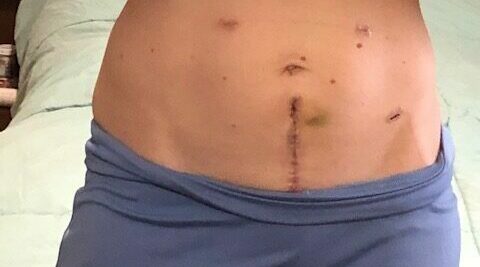
    Once he separated it from my bladder it ‘sprang’ up high into my abdomen, so he could not create the main incision over my 15 year old horizontal c-section scar as we had initially discussed, but had to cut vertically from just below my belly button down to my pelvic bone – he would have like to have it even higher, but decided he could make this work. He likened the tumor removal to birthing a baby via c-section.

    Groggy, post-surgery daze

    He had initially thought it had grown out of my mesentery – the web of blood vessels that holds your organs in place – which would have made for a complicated surgery, but instead it sprouted from my jejunum (part of my intestines) which was easier to deal with surgically – he took a foot an a half of my intestines and 4 nearby lymph nodes which all got sent out along with the tumor tissue for biopsy. The tumor had been fed by it’s own 1cm diameter blood vessel that he sealed off. We expected to get the biopsy results back in 5-7 days…

    OOF. That was a lot to process in a dissipating drug haze. But I got the message –

    – the surgery went well.

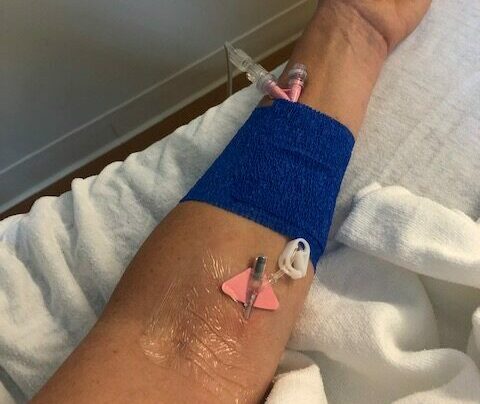
    At some point I found myself back in my isolated hospital room. My throat ached. I still wasn’t allowed to eat. I felt just as isolated there as I had pre-surgery. The IV in my arm had shifted and bent at some point and was creating a bloated, painful bulge. I called for assistance. 2 agonizing hours later a nurse moved the IV to my other arm.

    The delay in nurse response time sent me into a panic when I had a reaction to one of the iv antibiotics in the middle of the night. A few minutes after administering Flagyl, my face flushed, my fingers became tingly and I had severe dizziness. I couldn’t catch my breath. I buzzed for help. It was over an hour before anyone entered my room. My husband called the attending doctor.

    Much of the reaction had passed by the time the nurse arrived and she brushed off my concern – I didn’t know at the time it was caused by the antibiotic. She had the doctor prescribe me anti-anxiety meds. I don’t often ask for help, so when I do and I’m not believed, it’s pretty emotionally devastating. My panic turned into red-face anger. I refused to take them.

    It’s just before midnight and apparently a bed “just opened up” on a Covid negative recovery floor, so they moved me. This was a much better experience – open doors, the constant soft sound of busy nurses and staff that were just an “excuse me” away.

    Like all things in life, the move had it’s tradeoffs.

    My roommate couldn’t get herself to the bathroom on her own and frequently relieved her chronic diarrhea at her bedside commode.

    In the morning, when the nurse administered the iv antibiotic, the reaction was even faster. I called for help and she came right in – she could see the redness in my face, my shortness of breath, my dizziness. She knew right away what it was and what to do.

    It was incredibly reassuring to be believed.

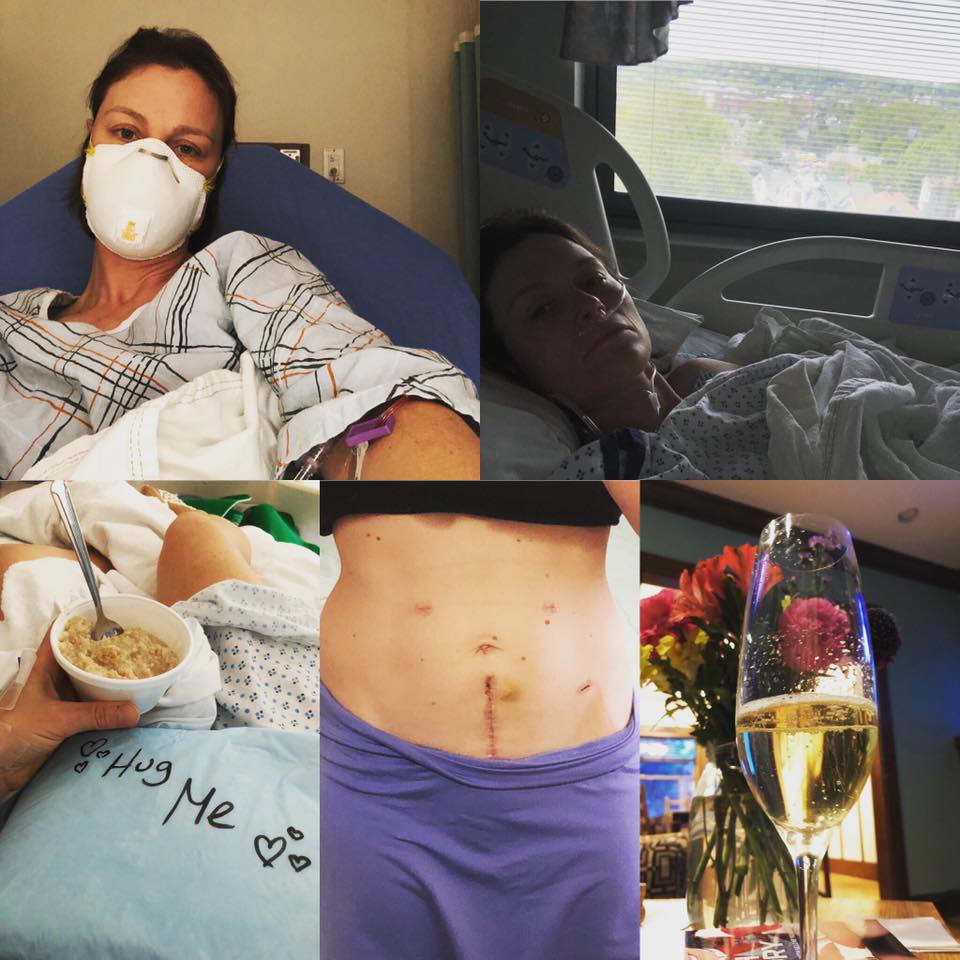
    My abdomen hurt, my throat was still raw (from the intubation tube) but I felt cared for here. My IV got dislodged again and was causing my arm to swell painfully so they moved it to my hand. The rest of the day was filled with lots of visits from doctors and nurses inspecting my incision site. One of the sweet, friendly nurses made me a ‘hug’ pillow to hold when I moved, walked or slept.

    I still hadn’t eaten anything. It was around 5 days at this point since I last ate solid food. Honestly, I wasn’t even hungry – hunger faded around day 3 and never reared up again. The doctor approved pureed, plain oatmeal and I diligently spooned it down with my usual meal of apple juice and chicken broth.

    My focus turned to, “What do I need to do to go home?”

    A breathing therapist (I have asthma) gave me a blow-tube and exercise instructions to use it for. The nurse asked me to start walking – walking as much as I felt up to. I took these challenges to be my ticket out, so the next day I was rolling my IV stand up and down the hallway & performing the breathing exercise every hour.

    I had stopped taking IV pain meds when I had been moved – I’m not a huge fan, and I know the quicker you’re off that stuff, the quicker you can go home.

    I graduated to plain oatmeal. When the attending doctor came in, all I could ask him about was what I needed to do to be discharged. He was pleased with the nurse’s report of my activity, but he informed me that I would need to have a bowel movement before I could leave.

    Ummm. Say what? I haven’t eaten solid food for nearly a WEEK!

    Madison’s Magical Money.

    Side note, when my daughter was 2, she swallowed a penny. It took that penny 10 days to travel through her much shorter than an adult’s intestines before it exited her system.

    How the hell long would it take for oatmeal to pass through my intestines?! This was not a timeline I was okay with.

    By the end of the next day, my continued activity coupled with my powers of persuasion – it could take a week for a meal to pass through my system, my house is just a half mile away, my husband’s promise to return me to the hospital should anything cause concern, and – this is the winning ticket – flatulence, was enough to get approval to get the hell out of there.

    Walking into my house never felt so amazing.

    Getting picked up from the hospital was a hazy dream. I was so happy to be going home. It was so emotional to see and hug my husband, my kids, my dog. I settled into the couch and slept – truly restorative sleep. It felt like the chapter to this crazy experience was finally wrapping up.

    Little did I know we were just getting started.

  • 2019 Came & Went.

    2019 Came & Went.

    Fall is my favorite season. Between the astounding colors and cool air it feels like a chapter ending and change in the air.

    This has been a strange year – the xc racing burnout that typically arrives in late August hit extra early in mid June, with stifling humidity and unusually high temperatures. Add to that burnout the declining vitality of my parents, their impenetrable façade of strength and energy crumbling away as their mortality races towards them. Any free time I might have between freelance work hours gets gobbled up by thankless hours upon hours of planning, teaching & coaching the Essex Offroad MTB Team, which underwent significant growth. Just when I get fed up with spreading my time too thin, I experience a rare, touching moment of appreciation or an over-heard comment that illuminates a positive impact and strikes me so deeply it feeds the next few hundred volunteer hours and the desire to spread the stoke of more women on bikes. Then there’s the aging of my 2 children, my oldest already in high school – I have a strong compulsion to spend as much time as they’ll put up with before they head out to make their own way in the world. All of these issues are pulling me in different directions.

    So it makes sense that the enduro scene has pulled me in and away from xc racing.

    The enduro discipline has all the fun of racing, hanging with friends and riding technical trails at mach speed without the pain and misery of redlining every climb relentlessly for 1.5-2 hours. It’s a welcome change of pace that has a much higher happiness to misery ratio.

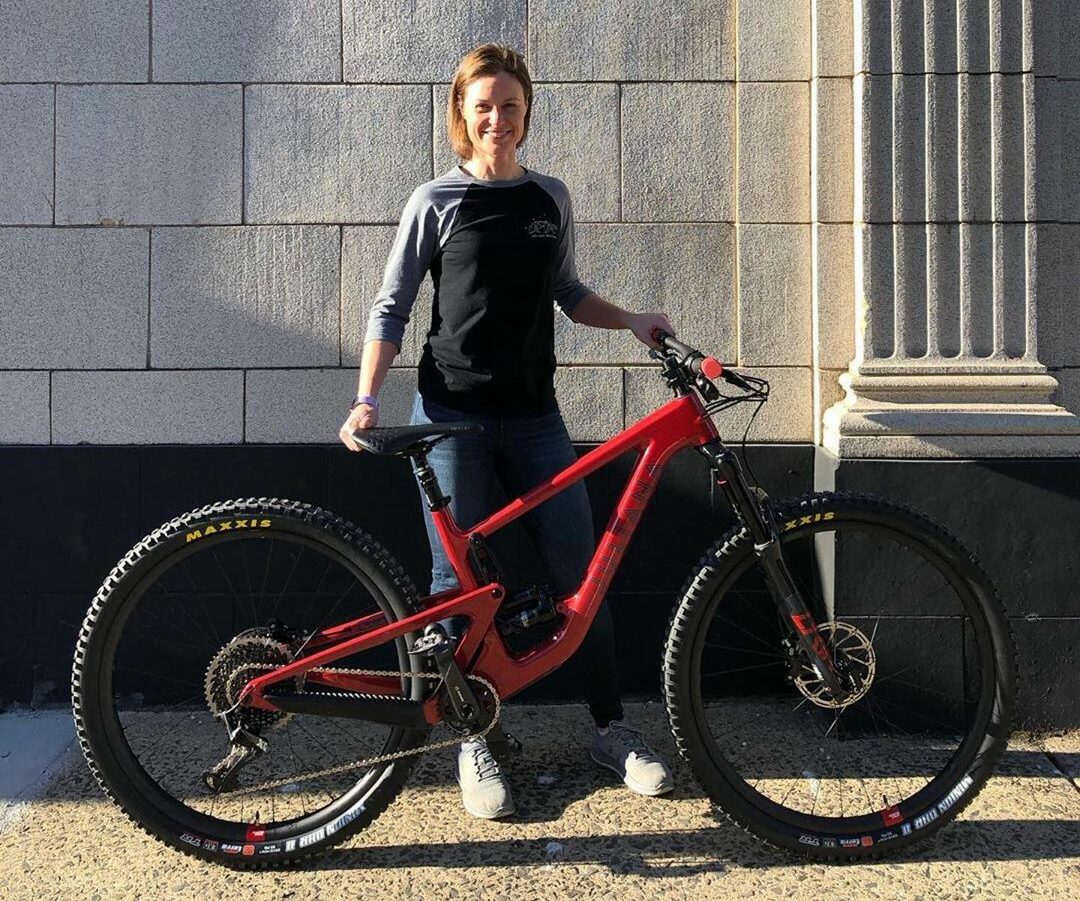
    With enduro races less frequent than xc events, I have more weekends free to visit my parents and irritate my kids with ‘family’ activities. Seems like a win-win all around, so it makes sense that I’ve decided on a Juliana Maverick for my 2020 racing endeavors!

    2019 Highlights in Photo Format:

    2019 Race Results:

    NJ State Cross County Champion – Pro Women

    H2H Series Cross Country Champion – Pro Women

    2019 Cross Country

    1st – Ringwood Rumble, NJ
    1st – Stewart PI Mousetrap, NJ
    2nd – Point Peter Pounder, NY
    3rd – Lewis Morris,  NJ
    4th – Mayhem, NJ

    2019 Enduro

    1st – MASS Enduro #8 – Glen Park, NJ
    2nd – MASS Enduro #2 – Glen Park, NJ
    4th – Maxxis ESC Specialized Enduro #10

  • Girls, You’re Welcome Here!

    Girls, You’re Welcome Here!

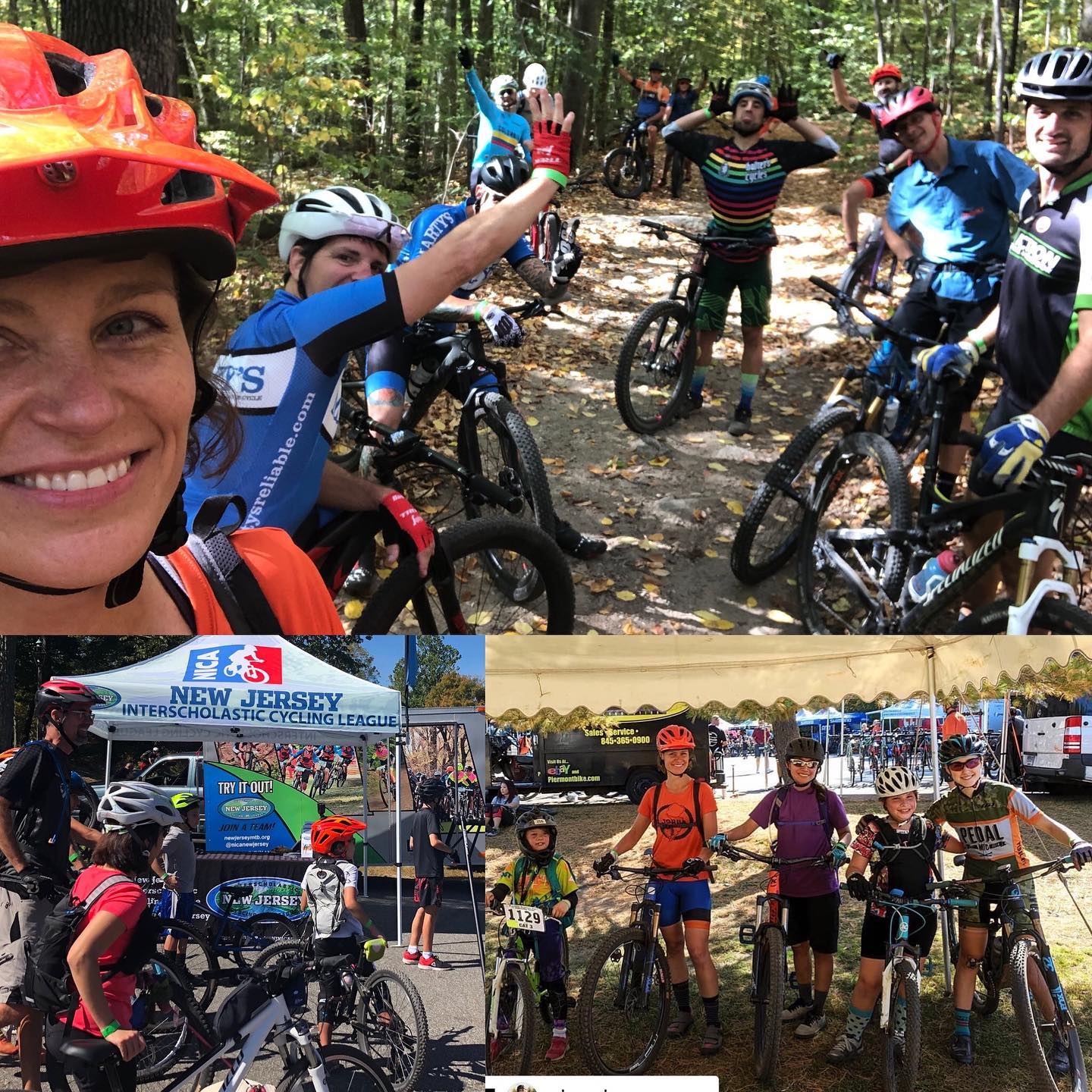
    Across the United States, there are 31 National Interscholastic Cycling Association (NICA) leagues striving to reach a more balanced male to female participation rate. In our own State of New Jersey, we are at a dismal 17%.

    I am on a personal mission to change that number, starting with my own NICA team – Essex & Verona Offroad. Last season I set a goal to double our girls squad. There was zero change.

    If at first you don’t succeed, try, try again

    As disappointing as that was, it did inspire me to take a look at things from a different angle. In the role of Social Media Coordinator for the New Jersey NICA League, I promote the image of the league. What I had been doing was representing our league, AS IT IS NOW. That means I was promoting an image of our league where girls are marginalized.

    You can’t ignore the facts

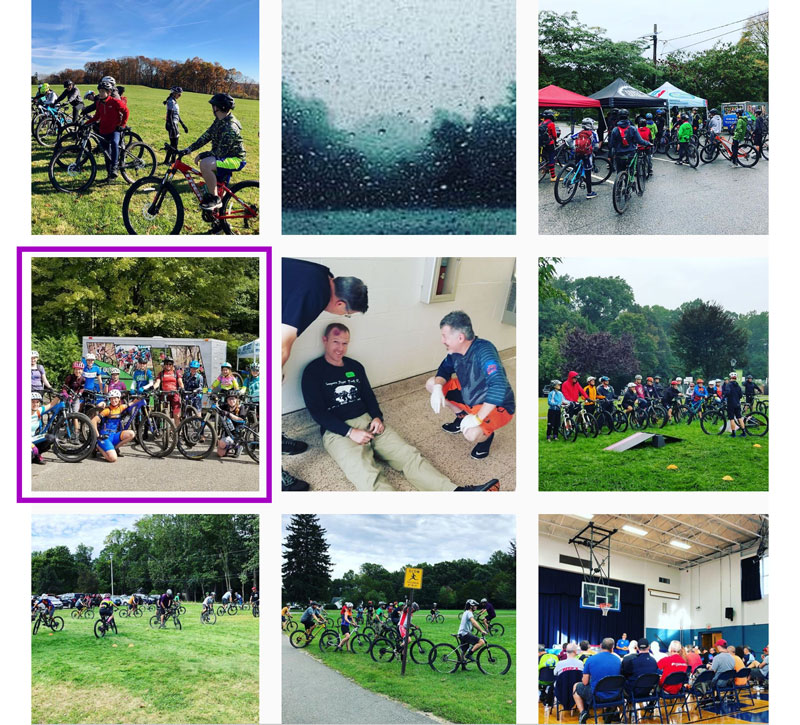
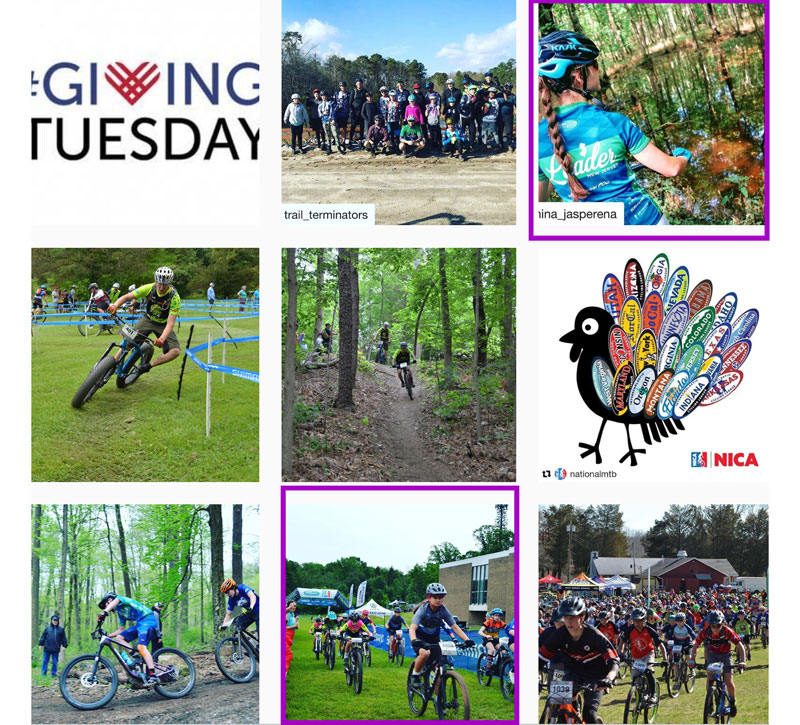
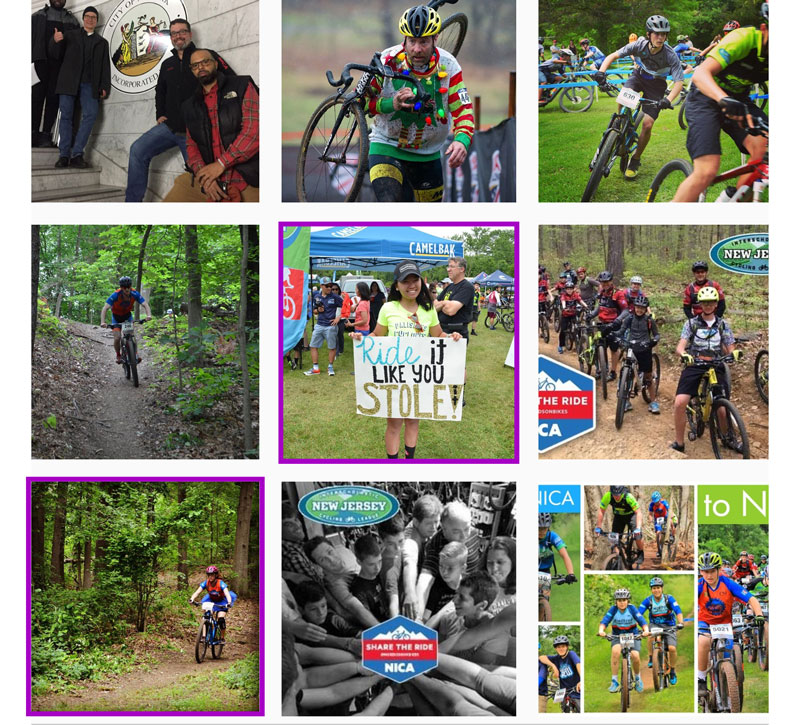
    Check out these screenshot from our league IG account during the 2018 – 2019 season, I’ve outlined the pictures of girls in purple:

    It’s pretty consistent that at best only 2 of the 9 images on any given scroll are clearly girls – students or coaches. There are females in the group shots, but they are very difficult to discern.

    I also took a look at some of our league and team collateral – and low and behold, the amount of images clearly representing girls was consistent or below our current 17%.

    What message do girls and parents perceive when the brochures, flyers, annual reports & social media feeds are flooded with pictures of boys, and every practice is also dominated by boys?

    Our league director overhead one prospective female athlete, who clearly enjoyed mountain biking, say she didn’t want to join her local team because she didn’t want to be the only girl.

    Stop looking at where we are, and focus on where we want to go

    I’ve learned I need to represent the league AS WE WANT IT TO BE – you know, if you build it they will come… or fake it ’till you make it.

    Our target audience here is at a turbulent stage of life – 12 – 18 years old. Most girls are in a heightened state of self-consciousness due to the state of their physical, emotional and social development.

    It takes a special kind of girl to feel completely at home as the only female, surrounded by boys and men, out in the middle of the woods. Are there girls who are comfortable in this situation – you bet. Is it a majority? No way. For those that are more guarded, the following subtle changes may help them feel welcomed and excited about mountain biking.

    How do we say, “Girls, You Are Welcome Here & You’re Going to Have Fun!” ?

    Here’s some food for thought – ask yourself the following questions:

    • Does your media features girls as much as boys?
    • Do you use this phrase: “Now recruiting boys & girls in 6-12th grade…” Why is “girls” always listed 2nd? Can you swap that around so it’s “…recruiting girls & boys…” ?
    • If your team has fan clothing, do you offer women’s and girl’s cuts, styles or products?
    • Do you regularly ask your female coaches and female students for feedback & ideas?
    • Have your asked your male students if they have sisters or cousins they can invite to a “Try It Out” event or practice?

    Fingers Crossed

    Will these suggestions make any difference? I don’t know. I certainly hope these changes will be adopted by the mountain biking community to create an inviting and encouraging environment for young women.

    Comment your ideas below because this is how change is made!  


  • Redemption in West Virginia!

    Redemption in West Virginia!

    Nationals. West Virginia. In 2017, I had my heart set on the Enduro National title for Women 30-39. I was having a great set of runs and then blam-o everything went south when I broke my back brake handle, rendering it useless. There was only one more stage for day 1, and with no ability to fix the brake until the day’s racing was over, I ran stage 4 with only a front brake. I fully expect to do some super-woman front jumps off the bike, but I just needed to roll through it and could make up time the next day. Unfortunately, I sprained my ankle during one of those dismounts… game over.

    So this year, I was determined to get through the Enduro in one piece. Priority #1 – no injuries or mechanicals. Priority #2 – go fast.

    Now, those priorities may seem at odds, but I fully expected to sacrifice speed for safety. That was a conscious decision.

    I planned 2 days for pre-riding the enduro stages. There were some similarities to last years course, and a whole lot of changes. Instead of 8 stages over 2 days, it was 7 stages in 1 day. And the transfers were brutal – miles upon miles of pedaling, often with quite a bit of elevation to conquer. I knew my XC background would help in this aspect and that some racers very well may miss the strict cut-off time to complete the stages.

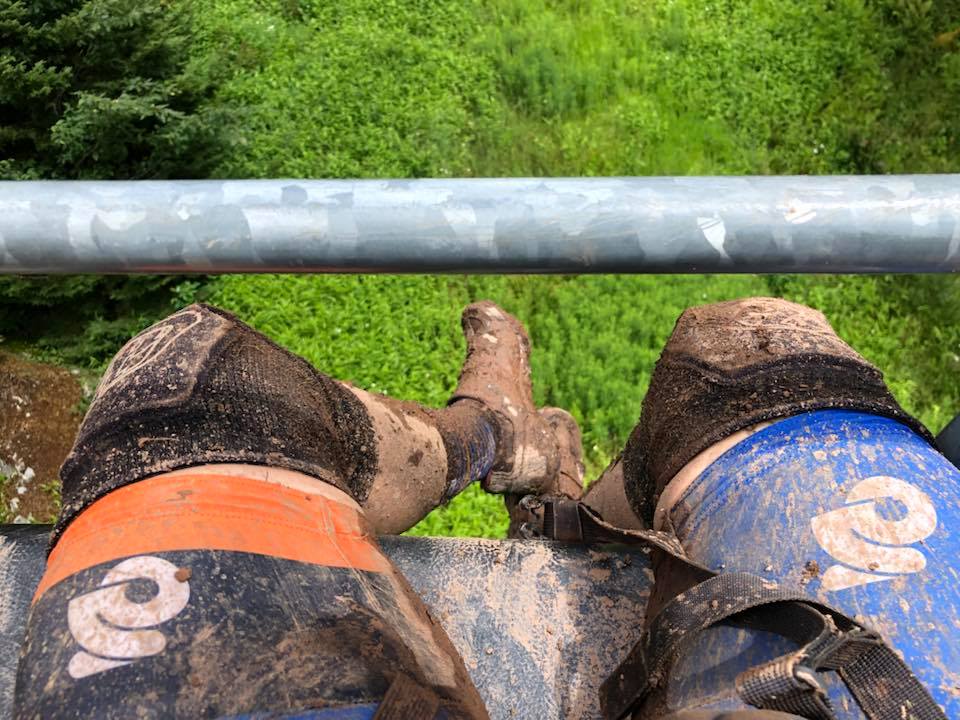
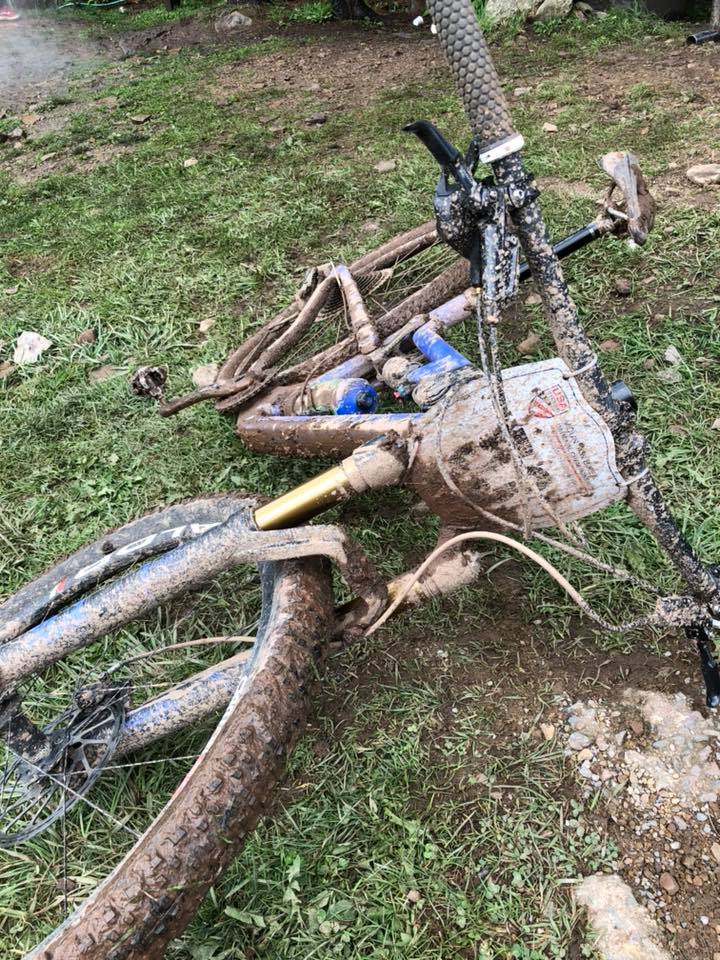
    Then there was the weather. The terrain at Snow Shoe is pretty gnarly, with off camber roots, monster drops and rock gardens galore. The first day of pre-ride it poured all day. The rocks were slick, the roots even worse. As I rode and re-rode sections of trail my confidence in my own technical riding abilities began to falter. On the second day or pre-riding the rain had let up a bit, but the trails had churned up a slick layer of mud on absolutely every feature. I felt like I was riding on ice. I could barely make it 50 feet without a crash, fall, dab or bobble. I was exhausted, I was bruised, I was a wreck. I wanted to quit. More than once I found myself extremely emotional with thoughts like what am I even doing here? running loops through my head.

    kristine contento-angell mud at nationals

    I reached out to friends and family. Their words and advice helped immensely. I changed my tires, and I changed my attitude. My goal was to finish the race in one piece and I was going to do that – without concern for the podium. I would dismount and run any of the sections I couldn’t clear during pre-ride. My redemption was in conquering the course, and that’s what I was going to do, even if that meant running each stage.

    On race day my pre-race nerves were at an all time high. Meeting and chatting with other racers always helps settle me down. The weather was sunny and warm. I started out pretty tense, but was able to find some flow and enjoy the bike park stages. The first few gnarly stages were still pretty slick with  mud, and I certainly had quite a few dabs, bobbles and crashes, but I was able jump right back up and back into it.

    At the end of stage 4 there was a timing tent displaying the current results. I walked right on by. Would checking stats help me finish the course successfully? No matter what position I was in, I’d feel pressure to ride faster & take more chances. Not part of the game plan here.

    The sixth stage I had planned to run a majority of. It was a relatively short stage, with super steep, rooty, off-camber stretches – and once you dab, it’s a long ways before there is a good spot to remount safely. I had re-ridden it over and over in practice the day before and could not for the life of me keep the bike upright. The steep drops were criss-crossed with off camber, slippery roots.

    kca at nationals - enduro - 2018 west virginis

    With the hardest transfers behind me, with 5 of 7 stages finished with zero mechanicals or injuries, I went into the stage feeling settled and almost relaxed. I was exhausted, but having fun, and I knew I was almost done and well on my way to achieving my goal. To my great surprise I cleared a huge portion that I had planned to run – not realizing it until I popped out of the woods. I was elated.

    The final stage was a bike-park flow run. My arm pump was severe, diminishing my ability to modulate the brakes with any type of subtlety. In the end, it wasn’t my fastest run on this stage, but I got down it safely.

    It was 7 stages, 5 hours and 32 miles or riding. Without a doubt, the most difficult Enduro I’ve ever completed. I made it though in one piece and felt complete personal redemption.

    Hours later the results came out.

    The awards ceremonially was a bit surreal.

    XC & SHORT TRACK!

    I had 1 day to recover before the Elite Cross Country & Short Track races. I pre-rode the courses in the morning. Watched my teammates and son race their categories of XC. My legs were feeling shot and my whole body ached. It didn’t matter, I was still riding yesterday’s high.

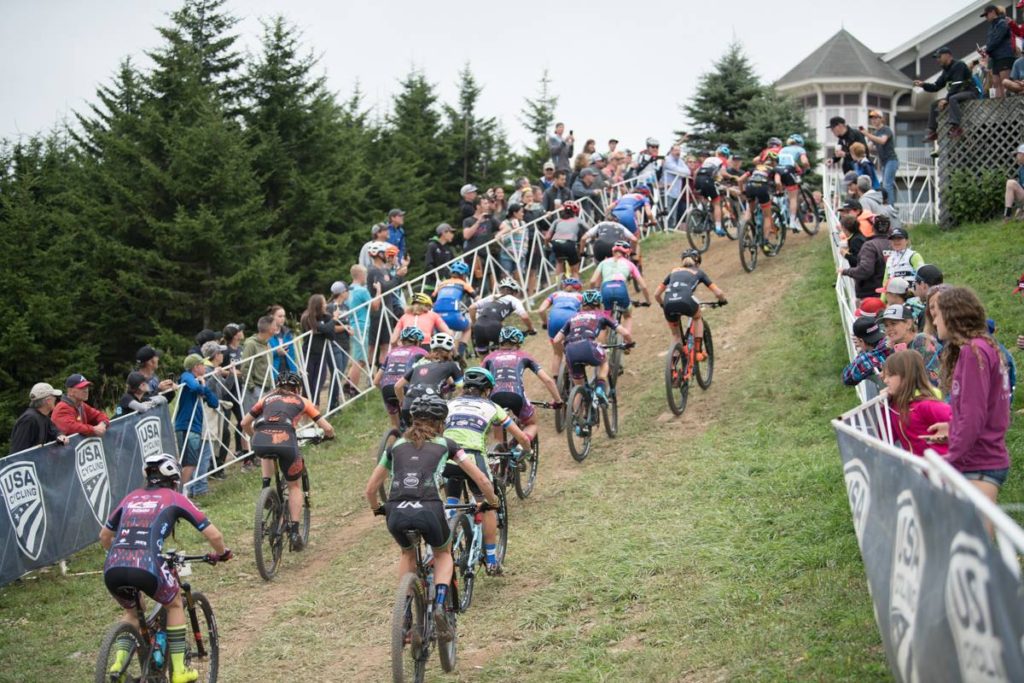
    First up was the Elite Cross Country Race. I had very little expectations of myself — just wanted to see what I could do with whatever I had in my legs. I fully expected to get pulled pretty quickly. The course started out on a nasty, absurdly steep grass climb, then into a lighting fast flow section that lead into a long slow stretch of super slippery roots followed by a ripping downhill on a gravel road, into a long gravel climb through the pits. Then a twisty, almost bike park like stretch into more gravel road climbing, then a really long, raw, wet rock garden, up to the A line rock jump and back through the start finish.

    Grueling to say the least.

    usa cycling 2018 nationals WV, start climb

    From a last row start, I worked my way back and forth through the pack.  Gaining spots on the descents and bleeding spots on the climbs. No surprises there. I got through lap 1 and figured, I’d probably be pulled at the end of lap 2, so I used that to motivate me up the climbs and to make passes. More back and forth. I was waved through to lap 3. Surprised, I dug in knowing this would be my last lap. I mean, have I ever finished on a lead lap with Kate Courtney at the front of the pack? I don’t think so. My legs were screaming, my skills were suffering from my exhaustion, but there were people cheering me on, some dancing and screaming my name up the last long climb. They kept me smiling and shifted my mind out of the the suffer zone.

    I pedaled hard into the start finish area and spotted the race official. He was waving me into the 4th lap. What? OMG. Why would he do this. What is he thinking?!? I pedal into the final lap. I couldn’t believe it. Once my shock (and if i’m honest, annoyance) passed, I dig in. I’m going to finish on the lead lap!

    I have my best run through the roots and I’m re-energized barreling down the gravel descent. The girl I’d been trading places with during the last couple laps is in my sights on the climb and I focus on reeling her in. I pass her by the feed zone and pedal on. The spectators have cleared the course to watch the leaders finish. My legs are shot, my whole body is spent, but still I find a way to pedal on. Finally, finally I’m heading into the start finish area and cross the finish line. Un-Freaking-Real.

    Sunday – Short Track

    Not much to say about this race. I poured every remaining bit of energy I had into yesterday’s XC race, so I’m not surprised to find I drop like a rock to the back of the pack, pretty much straight away. I get a few laps in and get pulled. Then I watch Ellen Noble, Erin Huck and Kate Courtney throw down attack after attack for an epic battle to the finish.

    Lessons from the week

    Success happens when I pick a strategy and stick to it.

    Believe in yourself. Your friends and family do.

    Don’t be afraid to ask friends and family for advice and encouragement.

    Focus on giving all I have to the moment at hand.

    My body can dig much deeper than my mind thinks it can.


  • Season Wind-Up

    Season Wind-Up

    My next target race is Nationals in West Virginia. With some humbling experiences at the Sea Otter classic fueling my passion to work harder and smarter, I set my focus on quality training and local races, mostly cross country but I take whatever I can find.

    I even jumped into an Eddy Time Trial!

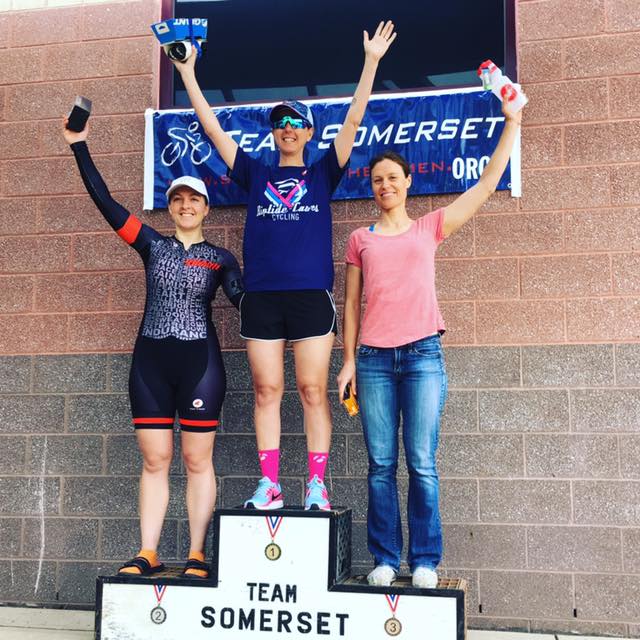
    Time Trial - kristine contento-angell 2018 3rd

    On the local scene, my race skills and race legs were starting to come together.

    I was beyond stoked with the size of the Women’s field at the Stewart Poison Ivy Mouse Trap. I was even more stoked with how awesome my fitness felt. I made a small mistake early on into the race – crashing and stabbing my handlebar into my quad. I was able to get back on the leaders wheel, and stay there, until that quad started cramping on the last lap.

    The most monumental of the xc races for me was the Lewis Morris Challenge. Typically, I have had poor results at this race venue – there is very minimal technical riding and a whole lot of climbing, plus quite a few road-racing riders give this race a shot and their road strength typically pays off big on this course. I headed in with a clear plan – I counted out 5 hills per lap, 3 lap total, and planned to attack each climb individually, focusing only on the current climb, planning to return to a lighter tempo pace in between the climbs, during which I could recover. It didn’t matter who else was on the start line, it didn’t matter what anyone else’s strengths were. Nothing else mattered. I was solely focused on my own performance on each individual hill.

    I executed my plan. It worked perfectly. I not only won the race, but I proved to myself that I can overcome my greatest weaknesses, opening the possibility that anything is possible.

  • April – California Grit

    April – California Grit

    Oh man, the trip to California aka, my “sanity tour” is usually a highlight of the season for me. I was heading into the first set of races at Bonelli Park with so much excitement. Winter and spring training had been tough, with relentlessly poor weather leading to mainly indoor trainer workouts, but those indoor trainer sessions had been more intense than previous years and my power gains were huge. I couldn’t WAIT to put those power numbers down on dirt! And with the super light, hardtale Santa Cruz Highball under me, I was ready to crush souls.

    The only soul, however, that was crushed, was my own.

    The art of trail speed gets rusty and crusty when it sits untouched. And if that indoor power can’t be transferred to trail speed, I might as well be wearing a lead jacket.

    Bonelli XC & STXC was a big o’ slap in the face.

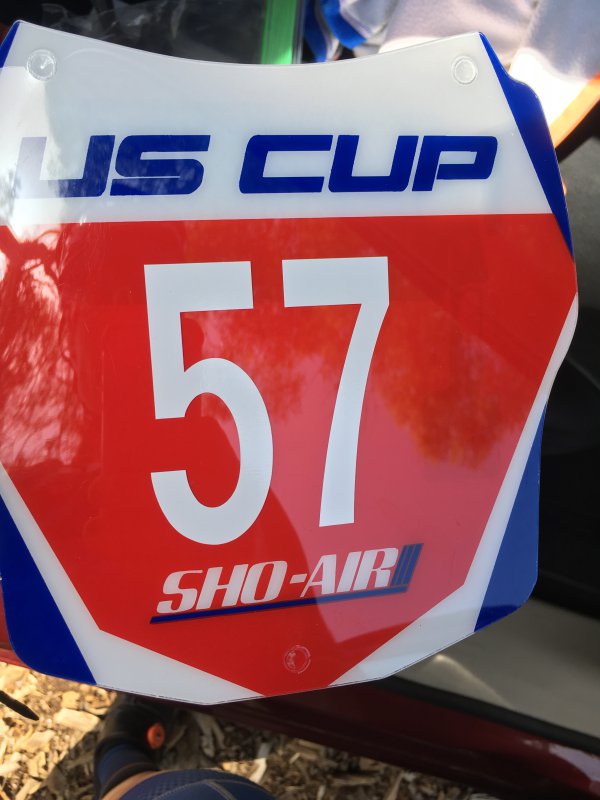
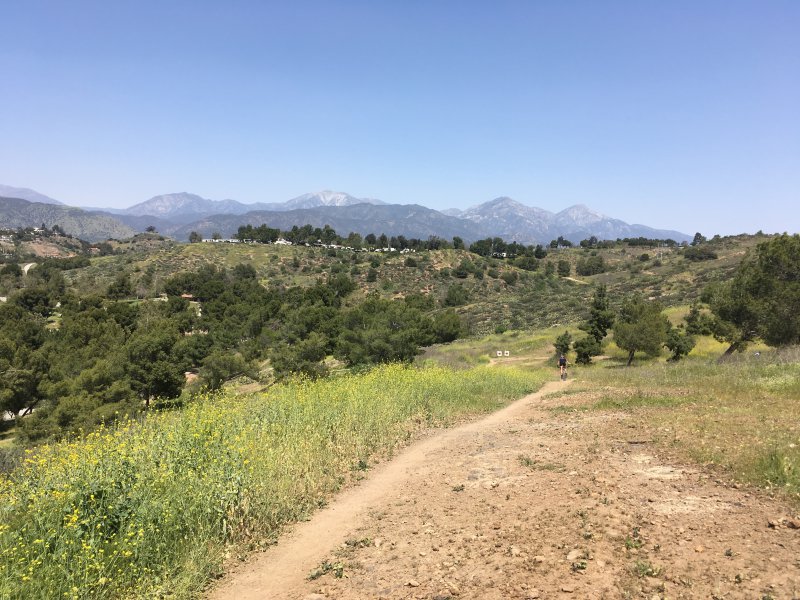
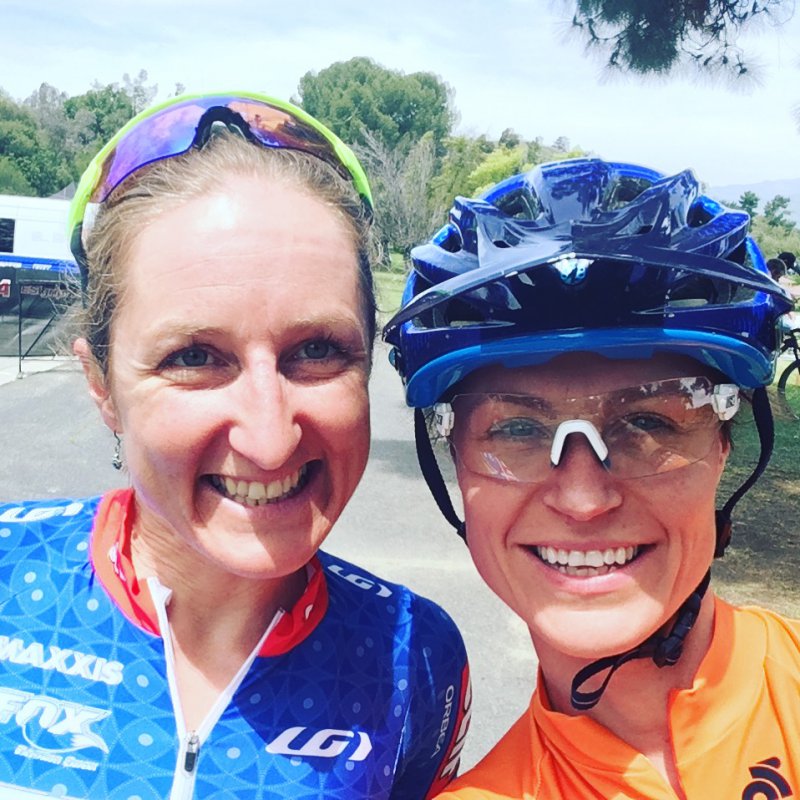
    Kristine contento-angell bonelli wake up call 2018 kristine contento angell bonelli park number kristine contento angell bonelli park single track bonelli park climb kristine contento angell

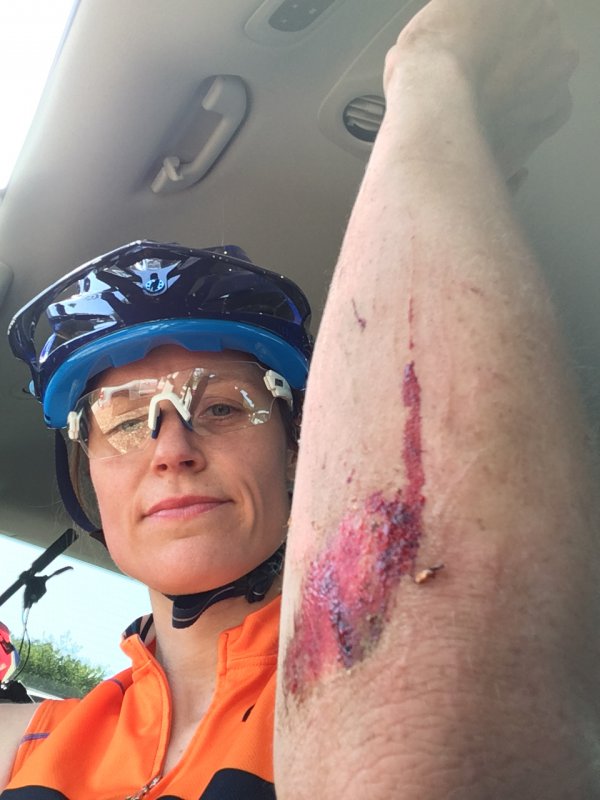
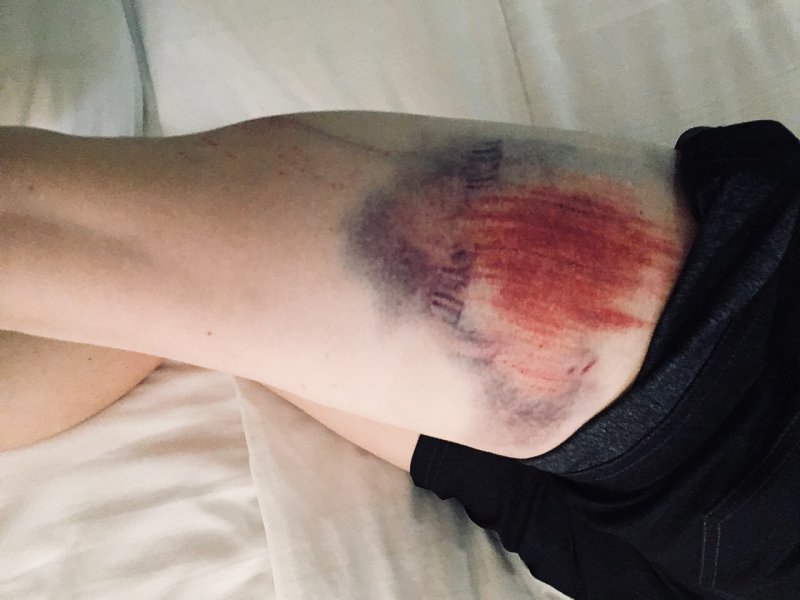
    KRistine contento-angell leg bruise at bonelli

    A few hours drive north and I have a chance to redeem myself at The Sea Otter Classic.

    I try to keep the idea in mind that every race and every experience is a learning opportunity. No matter how well, or how poorly the race goes – there is always some lesson to be learned.

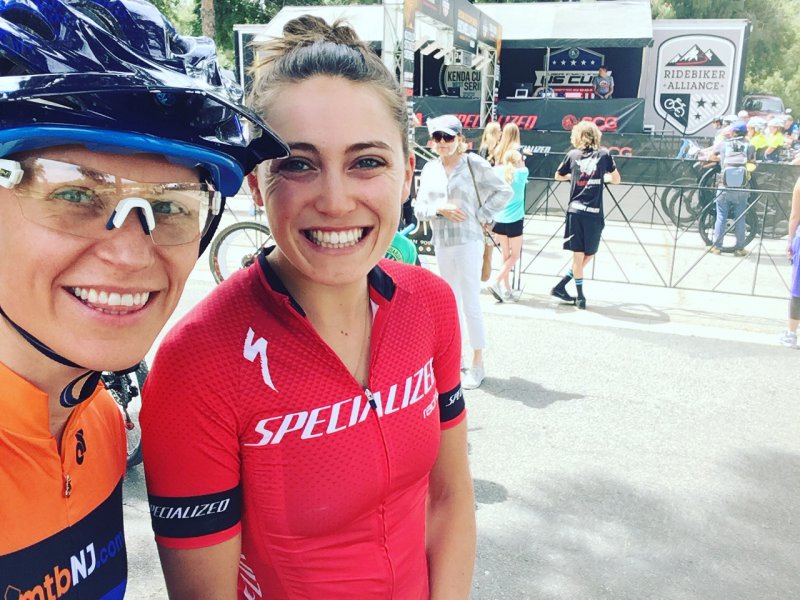
    On the plus side, the venue is so intimate, yet all the big names attend the race – UCI points – so I was able to fan-girl over some of my heroes. s.
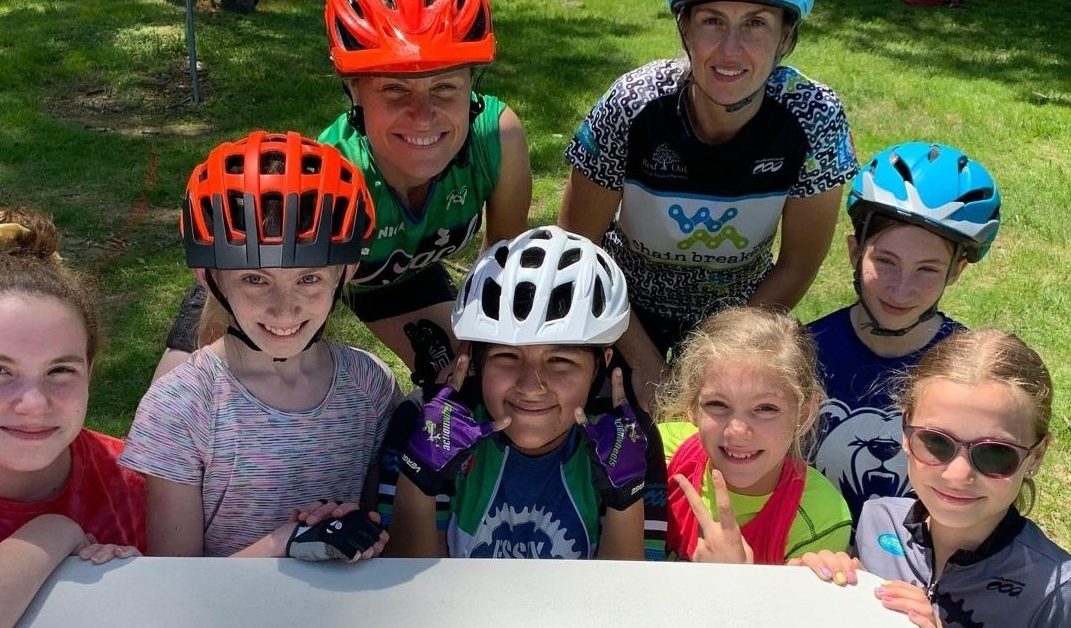
     

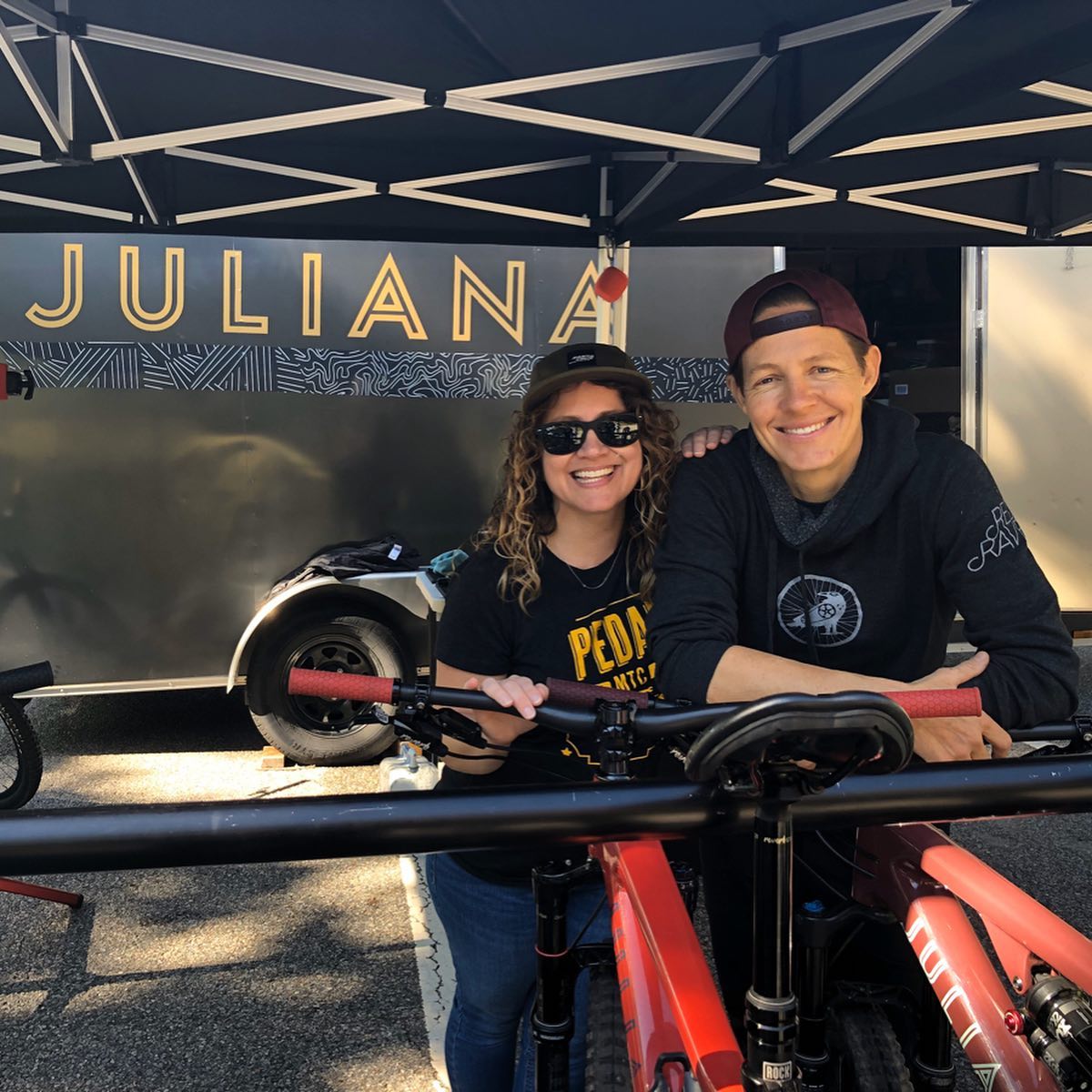
    At Sea Otter, the races are only a slice of the activities. The social side of re-connecting and making new connections through the week’s events and festivities tend to be just as enjoyable, if not more enjoyable than the actual racing. For me, the first stop was a trip to the Juliana / Santa Cruz Factory to pickup a bike for the enduro. I rode nearby trails to dial in the fit, then headed back to the factory for “Juliana Night’.
    My hotel was near the beach.

    The next few days I spent pre-riding the Enduro, XC & Short Track courses.
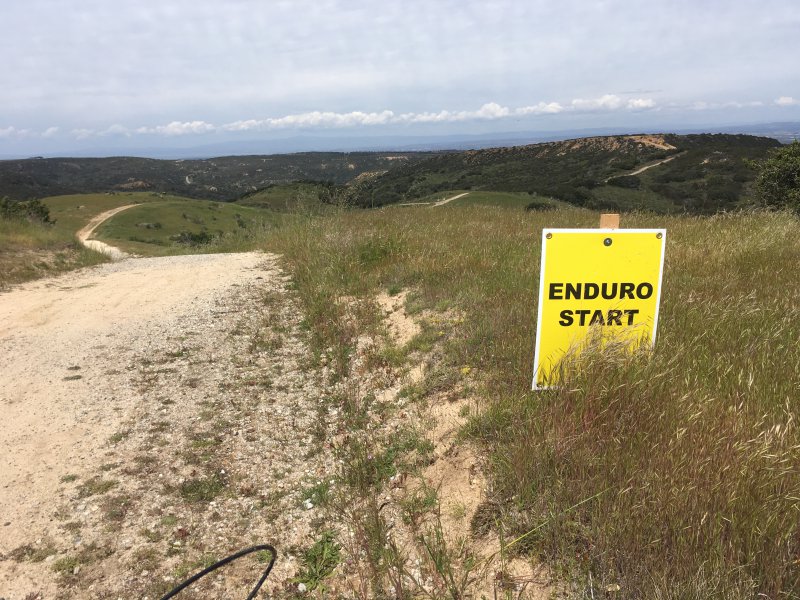
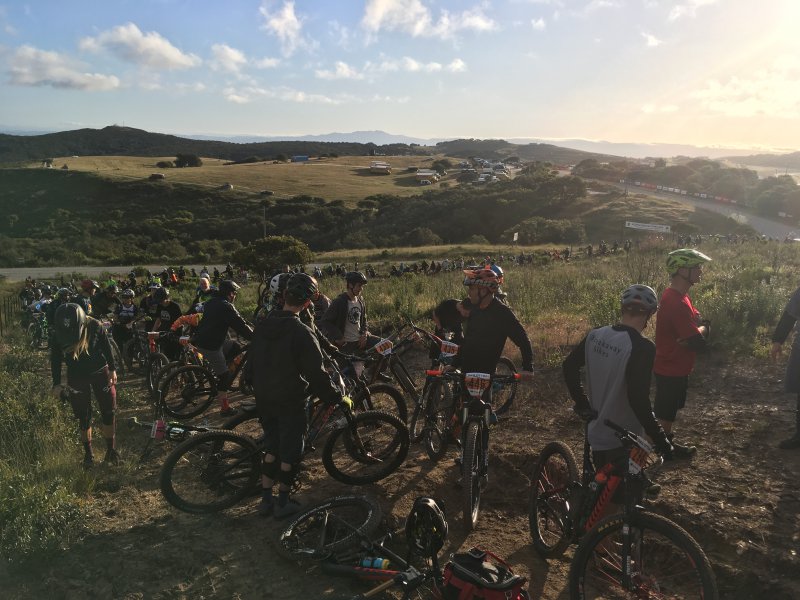
    The enduro gets a lot of participants. Here we are waiting for the officials to start sending off the racers in 30 second increments. One of the major benefits of racing the Pro category is being able to start at the front. Look at at that line!!
    Kristine contento-angell SEa otter enduro start 2018

    My Enduro result wasn’t awesome, but it wasn’t terrible either. I rode hard, but wasn’t feeling ‘up to speed’ yet. I had a sloppy slide out through a kitty-litter like corner, then caught the girl in front of me and couldn’t get by. Certainly an improvement over Bonelli last weekend.

    Five seconds of fame on PinkBike!

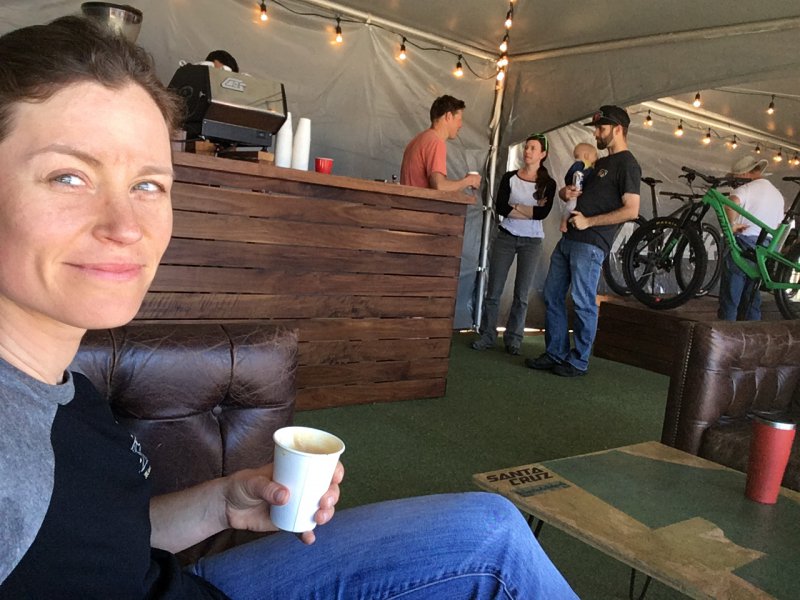
    In between races, I was either exploring the expo or hanging at the Santa Cruz / Juliana tent – with a sick espresso setup.

    Check this link out, if you want to see pics of the Sea Otter Expo: https://www.mtbnj.com/forum/threads/bonelli-sea-otter.44449/page-4.

    And plenty more fan-girl action.

    Short track was next up, but not before a really awesome night out with a pile of bike industry gals.

    My short track races was good. I was happy with how it turned out, I kept powering through each painful lap and finished on the lead lap. My result wasn’t great, again, but each race I was feeling more and more confident on the new bike and my power was starting to find it’s way into trail speed. The Sea Otter Short Track course is notoriously bland with lots of asphalt, gutters and sand. It is what it is.

    I was a bit delirious by the finish and cruised along the xc course to cool down. When my brain started functioning again I decided I’d do a cool down lap on the xc course. As I rolled into the first single track the Clif Luna Pro team rolled past doing their cool down. Katerina Nash & Magdalee Rochette rolled down the single track with me. I say hello and we all introduce ourselves – although they need no introduction.

    50 yards in we encounter a 7 foot tall chain link fence that is locked with a giant chain & padlock. 

    Without skipping a beat, Katerina hops off her bike, scales the fence and tells us to pass the bikes over. Which we do and promptly scale the fence after her. We then roll on chit-chatting and reviewing the rest of the course. I silently curse myself for wearing a skinsuit w/o pockets putting me in a position of having no phone to document the awesomeness of this event. Seriously, this may have been the best part of the entire trip.

    The next day, Saturday, is the Cross Country race. I put down what I can and am delighted to find I’m engaged in some back and forth battles throughout the lap, and the super steep ‘barf hill’ is a spot I can hammer and MAKE PASSES. I get pulled though – and that stinks, but overall I’m pleased to end on a positive note.

    Then it’s the dreaded, bike break down in the grassy field and off to the airport.

    I get zero sleep on the red eye home and pull into the driveway just in time to head back out to the Mooch Madness race – one of my favorites –  boy does it feel good to be on East Coast rocks.

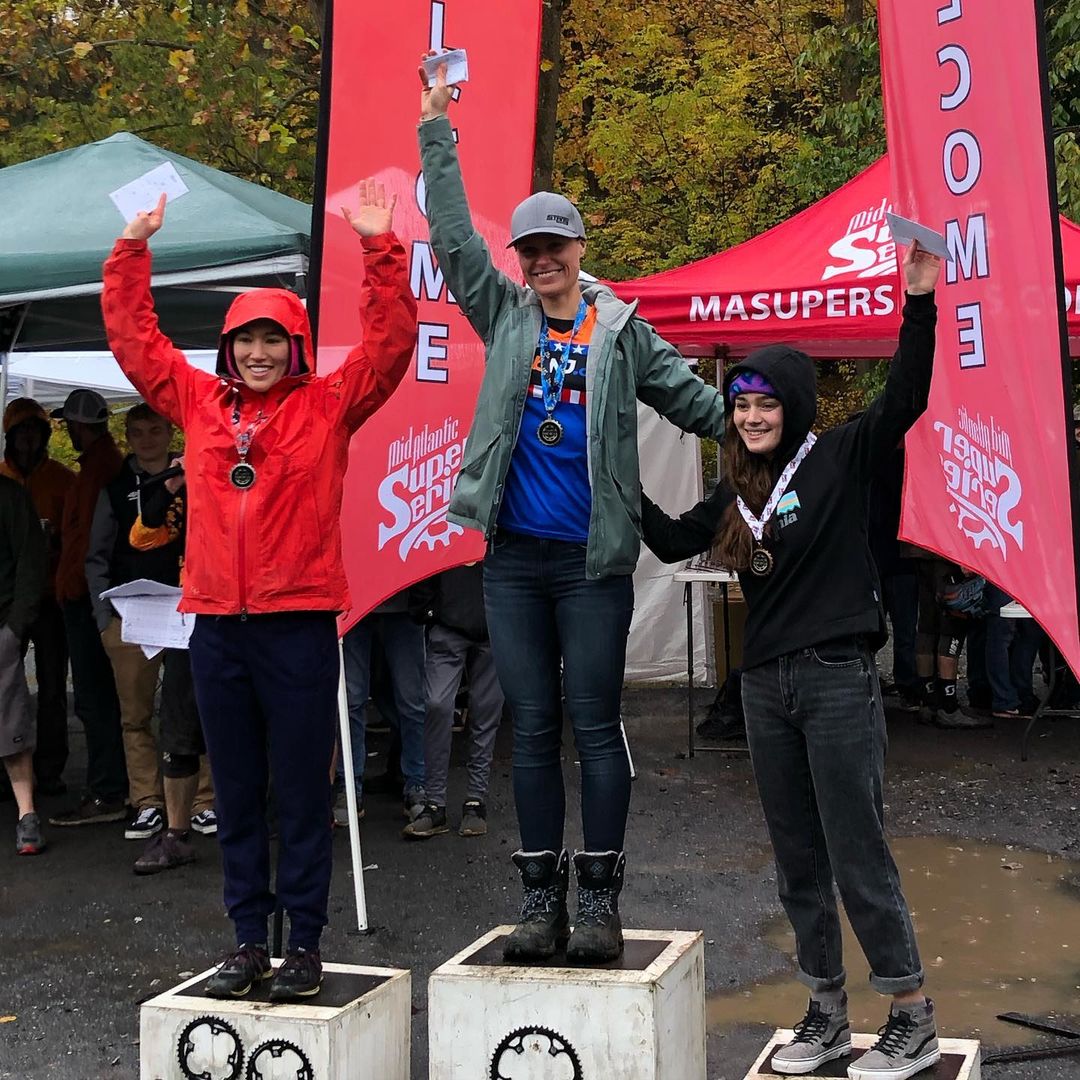
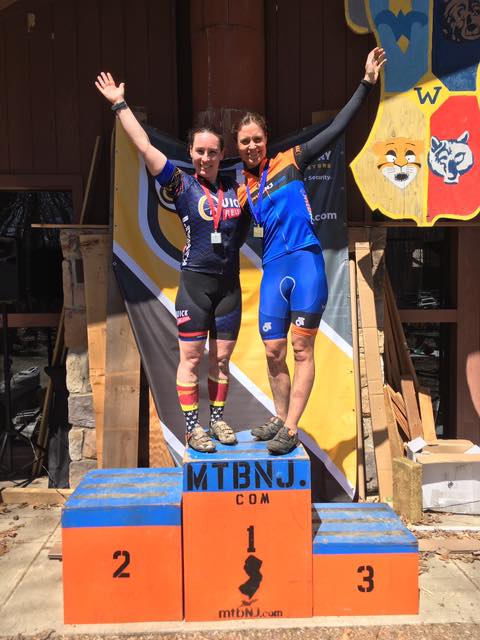
    mooch madness pro womens podium 2018 Kristine contento angell

    Finally home, it’s time to catch up on snuggle time with this gorgeous pup.

  • Rolling with the unexpected, March 2018

    Rolling with the unexpected, March 2018

    The slew of Nor’easters this past March has been a real downer for my race schedule. All four of the Cross Country & Short Track races I had planned to ease back into the racing mindset have all been cancelled.

    The silver lining is that I have been able to spend more quality time with my family. I’ve had more time to focus on diet/nutrition & interval workouts & high effort training. In fact, I’ve achieved a number of personal training PR’s this month. On the nutrition front, I’ve been playing around with the Paleo Leap meal planner and found a new favorite salad recipe (included below).

    Whole Food, Paleo nutrition plan

    My high school mtb team, Essex Offroad, has also been suffering with limited trail time. But we were fortunate enough to gain access to a giant parking lot (Thank you Metal Cutting Corp!) and we’ve held a few skills sessions in that space.

    Coaching mtb team Essex Offroad

    MTB skills coaching - Essex Offroad

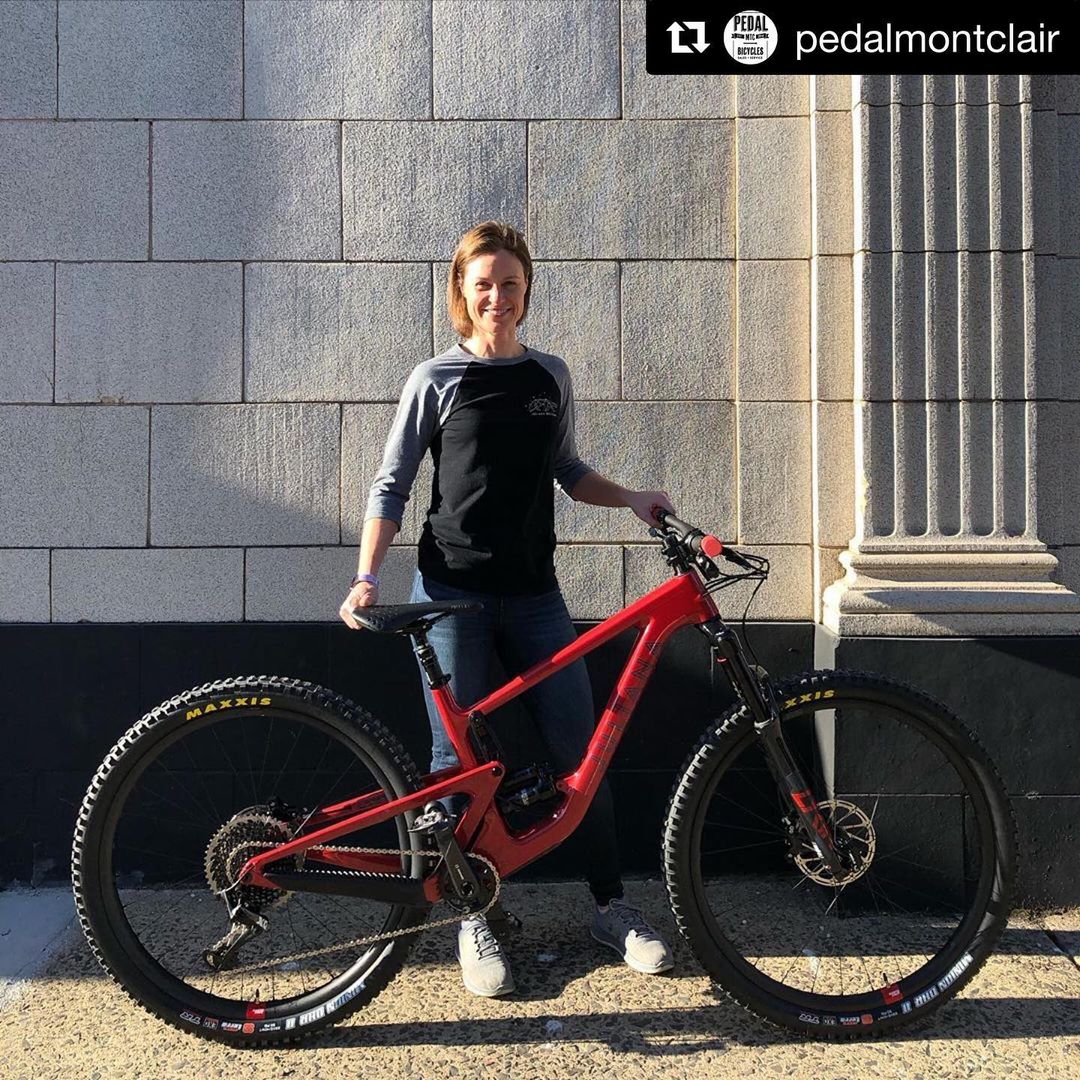
    The other shining moment of March was the arrival of my 2018 race whip – a Santa Cruz Highball! A big thank you to Pedal Montclair, Juliana Bicycles & Santa Cruz bicycles for setting me up this year. Their ongoing support has been amazing & inspiring.

    It’s a bit torturous to have such a beautiful weapon in my grasp and have no trails to ride it on! I decided to go with a hardtail this year to accommodate some of the less technical race courses I encounter through the season. And with my Juliana Joplin to attack the rocky, East Coast race courses, I’m perfectly equipped to handle everything on my schedule.

    With that in mind, I’m insanely excited to see how the Bonelli Park US Cup race & the Sea Otter races go. Wish me luck!


    Blueberry & Orange Salad
    (adapted from PaleoLeap.com)
    Ingredients:

    • baby spinach
    • fresh blueberries
    • 2 oranges, peeled and sliced
    • 1 avocado, pitted and diced
    • 1/4 red onion, sliced thinly
    • Walnuts

    Dressing:

    • 1/4 cup extra-virgin olive oil
    • 1 tbsp. fresh lemon juice
    • 3 tbsp. fresh orange juice
    • Juice of 1 lime
    • Sea salt and freshly ground black pepper

    Put all the ingredients on a plate or in a bowl. Whisk together the dressing ingredients. Pour dressing over salad.


  • 2018, here we go!

    2018, here we go!

    2018 is starting off with a bang!

    Ticked off a bucket-list item this weekend at Egg Harbor Township BMX Track! Had an absolute blast racing the 24″ wheel category (cruiser class – 1st place), the Women’s 20″ wheel category (expert – 3rd place) and jumped into the Pro-Am class too. (20″ – didn’t place). I love trying and learning new things and this did not disappoint. The women were just amazing – so welcoming, friendly, helpful and lightning fast!

    Kristine Contento-Angell 1st BMX Cruiser class

    The start gate was something totally new. Starting in a track stand and jumping as the gate drops is a whole ball of wax I had no clue about. Some great tips from John Gill Jr. and I was rocking those starts… well, the track stand part, the jump part can certainly use some work. 😉

    Kristine Contento-Angell BMX EHT - Jack frost race 3rd place 20" W class

    The track itself is like riding a pump track on steroids – and the burn that sets into your legs by the last stretch is brutal. I really enjoyed pushing through that fire. When it’s only going to last a few more seconds, it’s easier to push that burn aside and dig in – a very different experience to the mental fatigue of feeling that burn on an xc course.

    The day was chilly with gusting wind. A physically demanding aspect I hadn’t anticipated was shivering in between motos. No matter how much i bundled up with blankets, huddled behind wind blocks and layered on jackets, I simply couldn’t not stop the sheen of sweat from the race from chilling my body. Then, of course, the challenge became warming back up for the short and intense race. I had 9 separate race starts spread across 6 hours.

    Major shout out to Pedal Montclair for setting me up with the whips to make all this happen! #supportyourlocalbikeshop

    Big thanks to both John Gills for all their advice, instruction and for manning the New Jersey Interscholastic Mountain Biking – NICA tent.

    Juliana Bicycles #pedalmontclair MTBNJ.com O’Neal Gu_energy Elite Endurance Training Systems Spin Central Laundromat #onealriders#girlswhoshred #gojuliana #morekidsonbikes

    Photos: JPennucci Photography

    Next up is the H2hrace.com mountain bike series, race #1 – Mayhem in South Jersey.

    Kristine Contento-Angell BMX race